

The Impact Player Rule has been the most hotly debated concept in Indian Premier League (IPL) history possibly since its inception. A recent addition that was introduced to make T20 cricket more tactical and exciting, this rule has altered how teams pick their XI, approach batting innings, bowling plans and manage the game. Ever since it first started, the rule has been hotly debated amongst cricket fans with experts, former players and coaches divided over whether the same is good for the game or if it destroys an age-old balance of cricket.
In case you are wondering what is Impact Player Rule in IPL, how to use it, why it was introduced and what impact it has on players and teams, read this comprehensive guide. Here, we cover everything you need to know about the Impact Player Rule, from its core premise to real IPL examples including some key players such as Hardik Pandya, Rohit Sharma, MS Dhoni, Virat Kohli and Ravindra Jadeja and Andre Russell.
What Is Impact Player Rule in IPL
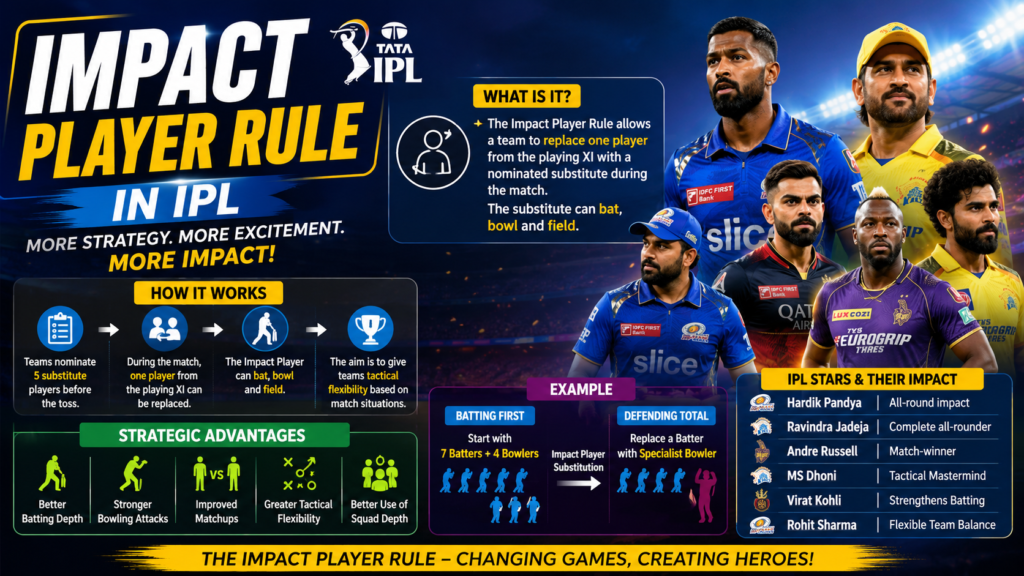
The Impact Player Rule enables a team to substitute one out of the playing XI with another player in the same game. That substitute is known as the Impact Player, and they are allowed to engage fully with the game in all three aspects – batting, bowling and fielding.
This rule was introduced primarily because, prior to the introduction of this requirement, the substitute players were largely restricted to fielding duties (and had a limited impact on affecting the outcome of a match). This was altered by the Impact Player Rule, which allowed teams to bring in a specialist batter or bowler for other players depending on the match situation.
To put it simply, a side can have one combination to start with and then adjust their batting or bowling order accordingly if they are batting first or chasing.
Well, this rule has made IPL matches a real treat in terms of dynamism and game plan!
History of the Impact Player Rule
The Impact Player concept was first introduced by the Board of Control for Cricket in India (BCCI) during domestic cricket. This rule was trialed in India’s premier domestic T20 tournament, the Syed Mushtaq Ali Trophy.
This worked out so well because teams used subs wisely to improve their chances of winning games. Coaches have added flexibility, and the extended limit provided a strategic element that fans enjoyed.
It was only after the successful testing that BCCI introduced the Impact Player Rule in IPL 2023. This rule has been a regular feature of the IPL ever since, and is now part of team building strategies as well as tactics during a match.
How Does the Impact Player Rule Work in IPL
Many cricket fans search for how impact player rule works in IPL, and the process is actually quite simple.
Before the toss, each team submits:
- Playing XI
- Five substitute players
During the match, one of these substitute players can be introduced as the Impact Player.
The substitution can take place:
- Before the start of an innings
- At the end of an over
- When a wicket falls
- During the innings break
Once introduced, the Impact Player becomes a full member of the playing XI and can perform all cricketing functions.
The player who is replaced cannot return to the game.
This allows teams to adapt to changing match situations and maximize their strengths.
Why Was the Impact Player Rule Introduced
The BCCI introduced the rule with several objectives in mind.
Increasing Tactical Depth
Modern T20 cricket is heavily influenced by strategy and data analysis. Teams constantly seek small advantages that can improve their chances of winning.
The Impact Player Rule provides captains and coaches with another strategic tool to exploit match situations.
Enhancing Entertainment
The IPL is designed to be an exciting and fast-paced tournament. By allowing tactical substitutions, matches become less predictable and more entertaining for viewers.
Creating Opportunities for More Players
The rule enables more domestic cricketers to participate in matches, giving them valuable experience at the highest level of franchise cricket.
Encouraging Flexible Team Combinations
Teams can now select lineups that are better suited to different phases of a match.
Impact Player Rule Explained with Example
Understanding the rule becomes easier with an example.
| Situation | Impact Player Move | Benefit |
| Batting First | Batter ➝ Bowler | Stronger bowling attack while defending |
| Chasing Big Target | Bowler ➝ Batter | Extra batting firepower |
| Spin-Friendly Pitch | Pacer ➝ Spinner | Better use of pitch conditions |
| Pace-Friendly Pitch | Spinner ➝ Pacer | More wicket-taking options |
| Death Overs | Batter ➝ Specialist Bowler | Improved control in crucial overs |
Example
| Match Situation | Before Impact Player | After Impact Player |
| Team scores 190/5 batting first | 7 batters, 4 bowlers | 6 batters, 5 bowlers |
| Team chasing 210 runs | 5 bowlers, 6 batters | 4 bowlers, 7 batters |
| Need wickets in final overs | Standard bowling attack | Specialist death-over bowler added |
| Need quick runs in chase | Regular batting lineup | Extra power-hitter introduced |
Imagine a team batting first.
The team selects:
Seven specialist batters
The IPL Impact Player Rule enables one player from a team’s playing XI to be replaced with another from amongst five players. In contrast to traditional substitutes, the Impact Player can sling one and bat as well and this gives teams tactical room for manoeuvre. This was introduced to make T20 cricket more strategic and exciting, allowing captains and coaches to adapt their XI to the demands of a match.
One wicketkeeper
Take, for instance, a team will bat first. They opt for seven specialist batters and only four frontline bowlers in their XI to bolster batting. A batter from the outgoing XI could be replaced with a bowler, who is introduced as an Impact Player, (maximum of five) after posting a competitive total. It adds an additional bowling option for the team in defending the target. Likewise, when a team is chasing a big total, it can substitute in another batter to bolster the batting order in place of a bowler.
Three bowlers
The most common instance of this is in IPL matches where often teams start with one batter more and then bring in a specialist bowler at the innings break. This type of tactical decision assists teams in balancing their ships and adapting to the flow of the game. As such, the Impact Player Rule is a strategic cog wherein franchises make better decisions and get ahead of their opposition.
Impact Player Rule and Famous IPL Players
Hardik Pandya
Hardik Pandya is one of the biggest examples of why genuine all-rounders remain valuable despite the Impact Player Rule. His ability to contribute with both bat and ball allows his team to maintain balance throughout the match. Even though teams can substitute players, Hardik’s all-round skills eliminate the need for frequent tactical changes.
| Player | Role | Impact Player Rule Effect |
| Hardik Pandya | Batting All-Rounder | Still highly valuable due to contributions in both departments |
Ravindra Jadeja
Ravindra Jadeja continues to be one of the most important players in IPL cricket. His left-arm spin, finishing ability, and exceptional fielding make him a complete package. The Impact Player Rule has not reduced his importance because he influences all phases of the game.
| Player | Role | Impact Player Rule Effect |
| Ravindra Jadeja | All-Rounder | Remains crucial due to batting, bowling, and fielding skills |
Andre Russell
Andre Russell is known for changing matches single-handedly. His explosive batting and wicket-taking ability make him one of the most dangerous T20 players. The Impact Player Rule cannot replace the value of a player who can dominate with both bat and ball.
| Player | Role | Impact Player Rule Effect |
| Andre Russell | Power All-Rounder | Retains elite value because of match-winning versatility |
MS Dhoni
MS Dhoni has always been known for tactical brilliance. While he is primarily a wicketkeeper-batter, the Impact Player Rule gives captains like Dhoni more strategic options. His ability to read match situations makes him highly effective in utilizing substitutions.
| Player | Role | Impact Player Rule Effect |
| MS Dhoni | Wicketkeeper-Batter | Benefits from additional tactical flexibility |
Virat Kohli
Virat Kohli benefits from stronger batting depth created by the Impact Player Rule. Teams can include extra bowlers and still maintain batting strength through substitutions. This allows top-order batters like Kohli to play more aggressively when required.
| Player | Role | Impact Player Rule Effect |
| Virat Kohli | Top-Order Batter | Gains support from deeper and more flexible batting lineups |
Rohit Sharma
Rohit Sharma has played a major role in IPL success through smart captaincy and explosive batting. The Impact Player Rule allows teams to strengthen bowling or batting according to match situations, helping players like Rohit maximize their strengths at the top of the order.
| Player | Role | Impact Player Rule Effect |
| Rohit Sharma | Opening Batter | Benefits from improved team balance and strategic flexibility |
Quick Comparison Table
| Player | Primary Role | Impact Player Rule Impact |
| Hardik Pandya | All-Rounder | Value remains extremely high |
| Ravindra Jadeja | All-Rounder | Importance unchanged |
| Andre Russell | All-Rounder | Still a match-winner |
| MS Dhoni | Wicketkeeper-Batter | Tactical advantage increases |
| Virat Kohli | Batter | Gets stronger team support |
| Rohit Sharma | Batter | Benefits from flexible team combinations |
Also read this: Highest Wicket Taker in T20 | India Women T20 WC 2026 Next Match | Deepti Sharma Bowling T20
Strategic Advantages of the Impact Player Rule
Better Batting Depth
The Impact Player Rule enables teams to bolster their batting order without losing much from the bowling arsenal. And franchises can include an additional batter while setting or chasing a target and then, once the innings is concluded, replace that player with a specialist bowler. Teams now bat deeper, to the accompaniment of pretty much constant violence.
Stronger Bowling Attacks
During a total ‘Defending’, teams can replace one of their non-striker batsmen with a specialist bowler through Impact Player. This gives captains more wicket-taking options and better control in the key phases of the match, namely the powerplay and death overs.
Improved Matchups
This rule allows teams to replace players tactically at specific moments in a match. In the first situation, captains feel free to introduce a spinner on a turning pitch (in other words, spin-friendly conditions) or a pace bowler on seam-friendly ones for some preferable match-ups against opposing batters.
Greater Tactical Flexibility
The major advantage of the Impact Player Rule is its flexibility. A million combinations are possible now as teams are no longer confined to a fixed playing XI and can factor in pitch conditions, match situation and opposing strengths into their gameplan, which has only added layers of complexity to the IPL puzzle.
Better Use of Squad Depth
The rule essentially guarantees that more squad members can participate in a match. Rather than simply idling on the bench, domestic and overseas talent could be used as Impact Players, allowing teams to optimize the value of their entire roster in a tournament environment.
Impact on Team Selection
The rule has transformed how franchises construct their squads.
Previously, teams needed players who could contribute in multiple roles.
Now, franchises can rely more heavily on specialists because substitutions provide flexibility.
As a result:
- Specialist batters have become more valuable.
- Specialist bowlers receive additional opportunities.
- Tactical squad planning has become more important.
- Bench strength has become a major factor in tournament success.
Impact on All-Rounders
The biggest controversy in Impact Player Rule is the Scenario involving all-rounders.
Why Critics Are Concerned
- All-rounders were traditionally the balancer in a team.Added strength with bat and ball.
- Teams can now either replace a bowler (or batter) with a batter (or vice versa), lowering the requirement for all-rounders under the new Rule 5.
- This may hurt the prospects of developing future all-rounders in India, believe many former cricketers.
Why Supporters Disagree
- Their supporters claimed elite all-rounders would never go out of fashion because they can contribute at any stage during a match.
- We have all seen that players including Hardik Pandya, Ravindra Jadeja and Andre Russell are still the most expensive in T20 cricket.
Impact on Domestic Players
The ImpactPlayer Rule has opened new doors for domestic cricketers in the IPL. This allows the franchises to field one more player during a match and this creates opportunities for many young prospects to showcase their skill on T20 cricket’s biggest platform. It allows for younger players to get valuable minutes and still be directly helping their squad.
Increased Match Exposure
With the implementation of the Impact Player Rule, back in 2023, several domestic players who had been warming up the bench for an entire season got a look in. The new regulation will afford teams to rotate the players amid differing scenarios of the match so that even young cricketers get more chance to play in high-pressure IPL matches and hone their skills.
Faster Development
Playing IPL regularly helps groom a player and gain confidence. They get to share the dressing room with international greats, deal with pressure situations and improve their decision-making skills. This serves for a quicker development that they cannot get from playing domestic cricket and so.
Better Career Opportunities
A player can tremendously increase his reputation by having some impact performances as Impact Player. Having a successful IPL season opens doors for more lucrative offers, recognition and also higher up the cricketing ladder. As a result, the rule has turned into an important arena for young homegrown talent aspiring to be professionals in cricket.
Benefits of the Impact player rule
More Exciting Matches
How The Impact Player Rule Has Made IPL Matches More Exciting And Unpredictable When tactical substitutions turn the tide of a game, fans are never without something to call for till the last ball.
Better Team Balance
Depending on the scenario of the match, teams can improve either their batting or bowling. It allows captains to fill team balances windows at critical junctures.
Greater Tactical Depth
There are more levers for captains and coaches. The fact that T20 cricket now requires you to plan and decide when and whom to substitute adds a whole other layer.
Stronger Batting Lineups
Teams can include additional batters at the start of an innings while setting or pursuing a target before replacing them with bowlers to give each side a more aggressive and deeper batting order.
Improved Bowling Options
Franchises can also utilize specialist bowlers as Impact Players when defending a score, providing them with additional wicket-taking options and more control in crucial overs.
More Opportunities for Domestic Players
The ruling expands the participation opportunities for young local players who otherwise may spend most of the tournament carrying drinks.
Better Use of Squad Depth
Teams can make better use of their entire roster. Backup players turn into tactical options, not just sitting benchwarmers throughout the season.
Higher Scoring Games
More batting depth reveals a willingness to play aggressive cricket, meaningful scores and entertaining run chases.
Adaptability to Conditions
By selecting the right lineup depending upon pitch conditions, weather and match situations, teams can ensure that the odds are tipped in their favour.
Enhanced Fan Experience
The Impact Player Rule, which adds a tactical dimension to the game, has become another topic of discussion, debate and excitement for fans making IPL matches a more exciting watch.
Cons of the Impact Player Rule
Disadvantages of the Impact Player Rule
The Impact Player Rule has probably come under a lot of criticism over several reasons; one big reason is that it dilutes the value of true all-rounders. Instead of batting all-rounders and bowling all-rounders, teams will now have the option to add substitute specialist batters or bowlers.
Disturbs Traditional Team Balance
Having fixed playing XI has been a norm in the game of cricket. At this time, the Impact Player Rule alters that balance because it gives a squad to use a further out-and-out specialist during the game.
Limits Development of Multi-Skilled Players
The future of quality all-rounders may be affected as young cricketers tend to aim at being specialists rather than becoming good batsmen and bowlers together.
Increased Dependence on Analytics
Teams rely more and more on data and match simulations to decide when to make substitutions. Takes the win out of instinctive captaincy and event decision making.
Can Create Competitive Imbalance
That renders strengthening of the bench more than ever as franchises with deeper benches benefit more from the rule.
More Complex for New Fans
The replacement rule and Impact Player rules may be perplexing even for some casual audiences who are unfamiliar with the regulation.
Less Value for Team Versatility
In the past, teams had to smartly compose evenly-weighted XIs. The fact that you can swap out players mid-match makes a versatile starting XI far less important than it once was.
Tactical Upper Hand Might Benefit Richer Teams
The rule can be exploited better by teams with high quality experienced domestic and international players than franchises that are low on squad depth.
Reshapes T20 Cricket
Certain former players and cricket purists think the rule changes the natural architecture of the game, steering cricket away from its age-old format.
Ongoing Controversy Among Experts
The debate on whether this rule has actually improved the game or damaged long-term player development lingers on among numerous cricket experts making it arguably the most controversial ofT20 innovations in recent IPL history.
Impact Player Rule Controversy
The Impact Player Rule controversy continues to divide cricket experts.
Some former players believe the rule damages cricket’s traditional structure by reducing the value of versatile players.
Others argue that T20 cricket is an entertainment-focused format and innovations are necessary to keep the game evolving.
Several experts have suggested modifications that would preserve tactical flexibility while protecting the role of all-rounders.
Despite criticism, the rule remains a central feature of IPL strategy.
How the Rule Has Changed IPL Cricket
Since its introduction, IPL cricket has evolved in several ways.
Teams now:
- Score more runs.
- Bat more aggressively.
- Use deeper batting lineups.
- Employ specialized bowling strategies.
- Depend heavily on tactical planning.
The role of coaches, analysts, and support staff has become even more important because substitution decisions often determine match outcomes.
Future of the Impact Player Rule
The future of the rule remains a major topic of discussion.
Possible developments include:
- Adjustments to substitution timing.
- Restrictions on replacement categories.
- Expansion into other T20 leagues.
- Further experimentation by cricket boards.
If the rule continues to improve entertainment value while maintaining competitive balance, it could become a permanent feature of franchise cricket around the world.
Conclusion
This has revamped the nature of IPL cricket fundamentally, particularly with regards to the Impact Player Rule. The theory in part is that the rule will give teams more tactical flexibility, (one-in-one-out), enhanced strategic nuance and elevate the possibility of players to do their bit in a match. Critics attribute its impact on all-rounders and for breaking team balance in traditional ways to be disadvantageous, while others see it as a great addition to the excitement and unpredictability of T20 cricket.
IPL live fans wondering what impact player rule in IPL need not worry, it is a revolutionary tactical opportunity which will allow teams to adapt on-the-fly hitherto unseen opportunity and pull ITD efforts. Whether you see it as a groundbreaking enhancement, or a contested trial, the Impact Player Rule has quickly emerged as one of the most defining aspects of recent IPL cricket and will continue to forge the future for many years.
FAQs
1. What is the Impact Player Rule in IPL?
The Impact Player Rule allows a team to replace one player from its playing XI with a substitute during the match. The substitute can bat, bowl, and field like a regular player.
2. How does the Impact Player Rule work in IPL?
Teams nominate five substitute players before the toss. One of these players can be introduced as the Impact Player at specific stages of the match, depending on tactical requirements.
3. Can an Impact Player bat and bowl?
Yes, an Impact Player can fully participate in the match. They are allowed to bat, bowl, and field just like any other member of the playing XI.
4. Why was the Impact Player Rule introduced in IPL?
The rule was introduced to increase tactical flexibility, improve entertainment value, and provide more opportunities for domestic players in IPL matches.
5. Does the Impact Player Rule reduce the value of all-rounders?
Some experts believe it does because teams can substitute specialist batters and bowlers. However, elite all-rounders still remain highly valuable due to their ability to contribute throughout the match.
6. What are the advantages and disadvantages of the Impact Player Rule?
The main advantages include better team balance, greater tactical flexibility, and increased opportunities for players. The disadvantages include reduced importance of all-rounders and concerns about changing the traditional balance of cricket.