
Indian Premier League (IPL) is more than just a cricket tournament — it is a multi-billion-dollar sporting ecosystem that runs on precision, strategy and an artfully designed IPL Selection process. Bigger franchises, higher bids and player contracts are ruled by specified BCCI selection rules that keep balance in the competition while still allowing individual franchises to create melted identities of their squads.
Knowing the ins and outs of how an IPL auction works is not only important to cricket lovers but also there are many other analysts, sports managers and fans who would want to understand what lies behind the strategic brilliance that each and every match brings.
Long before a single ball is bowled, work begins for the IPL selection. Franchise scouting, registration with BCCI, checks in the IPL player registration process, salary cap allotment and retention then the wait of any cricket lovers is for the IPL auction – be it a mega auction or a mini auction as per the year in cycle. Every moment is layered with rules, negotiations, and pivotal decisions that will shape franchise destiny for years.
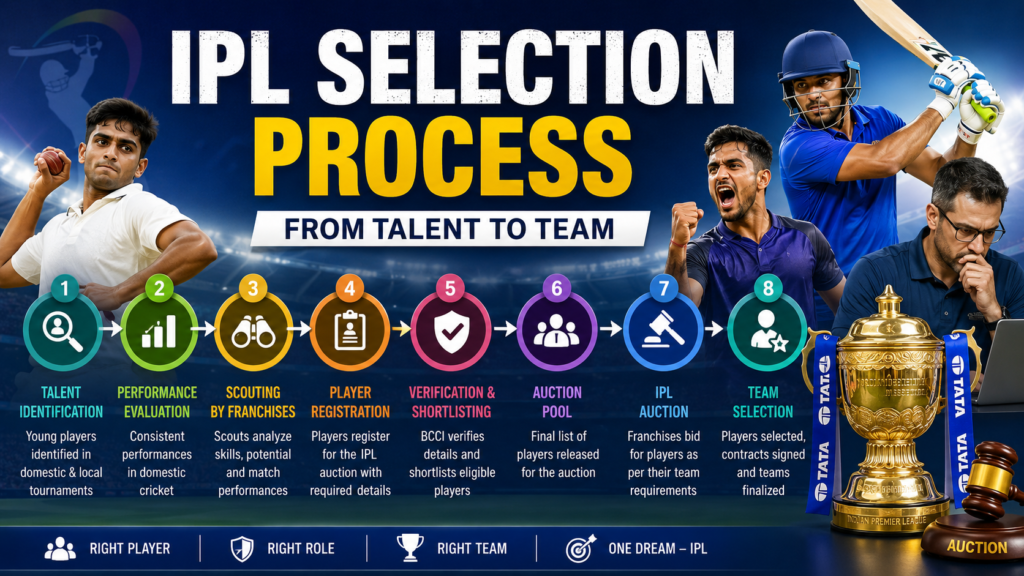
IPL Selection Process Table
| Phase | Description |
| Scouting | Talent discovery across tournaments |
| Assessment | Performance and fitness evaluation |
| Registration | Official IPL auction entry |
| Shortlisting | Selection for auction pool |
| Auction | Team bidding process |
| Selection | Franchise acquires player |
| Contract | Agreement signing |
| Squad Entry | Official IPL team inclusion |
Understanding the Two Types of IPL Auctions
Understanding the depth between IPL mega auction rules and a regular mini auction is the first step before going into its mechanics as both formats differ hugely in terms of scope, strategy and player dynamics.
The Mega Auction
Basically, a mega auction takes place every few years — usually after every three seasons — and is the biggest event in the IPL player draft cycle. Since this is a mega auction, there’s an actual restriction on how many players franchises can retain (usually between three to five depending on when the next BCCI guidelines for overseas availability and squad rules change) so most of the player pool goes back into the auction.
This leads to a huge pool of participants composed of veterans as well as uncapped Indians hitting the auction floor. Timing: IPL player auction mega auctions are a mix of emotion and drama as teams tend to go through a full squad revamp or re-shaping process.
The mega auction does swing the pendulum right down. The core of a team that ran away with last season may find its way divided between rival franchises. The format lends itself to a new kind of alliances, new plans, and daring bids — testing bidding strategies just as much as franchisees. Teams with deep pockets and sharp analysts often come out the big winners.
The Mini Auction
On the other hand, a mini auction is held once in a year for franchises to fill gaps in their existing squads. At this point, teams that have held on to most of their core squad use the mini fetch to sew a few loose threads — bring in a specialist spinner, bit player or an overseas fast bowler. The mini auction has a smaller pool, and is generally condensed, which makes it more tactical than theatrical. Even in this smaller field size, a right-to-match card and some deft player retention moves can completely turn the tables.
Team Retention Policy: The Foundation of Squad Building
Code of Conduct Below I share with you the team retention policy which is core to the entire IPL selection process. Franchises have to send the BCCI their retention and release lists before any auctions happen. IPL squad selection rules state that teams can keep a certain number of players, and each retention slot is fixed in price will be deducted from the franchise’s salary purse regardless off whether the player’s value in real market terms.
Retention decisions are perhaps the most difficult tasks that cricket management can face. Say, a franchise wants to retain five key players, but then they may have to be careful with the purse management before heading into the auction. On the flip side, letting a star go in order to save some bucks opens up the door for competitors to snag that top player (now probably at discount rates) or more accurately, only opening said discount bidding floor.
The capped and uncapped players are also covered as part of team retention policy. Players are paid higher for retaining capped players, or who have played international cricket representing their nation. Franchises that have supported uncapped players from their academies over the years can retain them at these price points, making them an attractive target. This differentiation is critical in making sense of the difference between capped vs uncapped players for IPL.
The Right to Match Card: A Powerful Strategic Tool
The Right to Match (RTM) card is one of the most complex and sometimes confusing aspects of the IPL player auction process. A franchise uses an RTM card to retain a player it has released, by entering a bid equal to the highest offer another team has thrown its way in the auction. Such a mechanism was implemented in order to offer franchises the “umbrella protection” — which would allow them to hold on to certain stars without paying full price right away.
The mechanics of the RTM card in IPL player retention is a lesson in timing and psychology. Unlike the original franchise that can elect to match any offer, teams with a player released into the auction pool often go full steam ahead in bidding on them. Resulting in a situation where: the rival is forced to over-pay for RTM or risk being able to bid too low, losing out on a player but also allowing him back into his original franchise at a bargain rate.
It was this RTM card that threw the most exciting moments of IPL auction history. Some franchises have used it to re-sign big name players that generated intense bidding wars, while others simply opted not to use their RTM and tried changing the makeup of their roster altogether. The maximum RTM cards available to each team in any season is limited, and played according to specific BCCI-approved selection guidelines designed to mitigate against teams using this mechanism as a method to subvert the spirit of the open auction.
Salary Cap and Purse Management: The Science of Smart Bidding
The IPL employs a harsh salary cap, which is the total budget with which a franchise has to bid for player contracts for a given season. The BCCI sets a salary cap and regularly reviews it to keep pace with inflation, the market growth of the league and for competitive balance reasons. Because for every rupee spent on player retention, the individual salary purse to spend at the auction decreases, and salary purse management is one of the most important pre-auction exercises.
Top contributors come from the salary cap. Out of nowhere, franchise bidding strategies are born. If there are any pockets to fill, those teams with a Smaller amount of purse remaining have to be as careful as possible and only use the Money in Roles that the Team believes are genuinely gaps. With rather deep pockets, teams are able to bid liberally on multiple players and even inflate prices with the intent of either driving neighbors up or out so that rivals have to literally pour their resources into bidding on one single player.
The salary cap in IPL, therefore, has a significant influence on team-building strategy — it makes franchises not just think about which cricketers they are acquiring but the actual financial cost of the squad in relation to balance.
Getting a top-class overseas opener, or a good spinner and two to three dependable Indian middle order batters in the same auction is what any team could hope with a well-managed purse. While it leaves a team with half its purse being spent on one player and cutting desperately to fill key places in the squad with base price uncapped options.
Also read this: Impact Player Rule | Highest Wicket Taker in T20 | India Women T20 WC 2026 Next Match
Overseas Player Participation: Navigating the Quota Rules
The overseas player restrictions are the first part of IPL structure that comes to mind. No franchise can have more than four overseas players in the playing XI of any particular match. But overall teams can hold onto more overseas players — generally up to eight — that can be swapped in depending on pitch conditions, weaknesses in opposition and injuries. This adds a captivating strategic dimension to both the auction and the playing XI selection process.
The BCCI guidelines for international participation in the IPL are meticulously crafted to preserve up-and-coming Indian talent, while at the same time not allowing the competition to devolve into an exhibition series that would diminish its jazz appeal as a premier global T20 league. This means franchise scouts will need to find not only the four best overseas players in the world, but a depth of eight who can twiddle their thumbs and adapt over multiple venues across India’s myriad playing conditions.
The mark on overseas players also puts an edge in the auction room. If a franchise has already retained three quality overseas pacers, it may divert its auction spend on Indian all-rounders or specialist batters with just one remaining overseas slot. It is also through those decisions, informed by the total quota of overseas players available, that one realises just how entrenched strategies for winning an auction and thoughts on squad formation are within the larger rules about IPL squads themselves.
The Role of Franchise Scouts in Identifying IPL Talent
Although the auction may capture most attention as part of how player availability is determined for selection in the IPL, it covers just one facet of a year-round player-availability resource management process. Franchise Scouts and the IPL- Franchise scouts in and how franchise scouts identifies talent in IPL These days, elementary analytics have become an enterprise in itself — modern IPL franchises have full-fledged analytics departments who almost stalk domestic circuit performances and scavenge metrics of youth tournaments, statistics from state teams and even club cricket from around the world.
They scout Ranji Trophy matches, Vijay Hazare tournaments, Syed Mushtaq Ali Trophy games as well as domestic T20 leagues across other countries — looking for players suitable to each specific role need of the franchise. Any side aiming to find death-overs expert will have scouts whistling the names of bowlers who rarely leak more than eight runs in the last four overs of domestic T20 matches. A team that is looking for a power-play hitter will use strike rates from hundreds of innings in the first six overs.
This kind of scenario is what differentiates successful IPL franchises with a track record, from teams that simply rely on instinct. Come auction day, the teams with the most exhaustive scouting reports know exactly who they want to bid on, for how much and at what point they should step away: That makes team management as crucial a factor in IPL player selection as players themselves.
The IPL Player Registration Process
| Step | Process | Description |
| 1 | Registration Opens | BCCI invites players to register for the IPL auction. |
| 2 | Application Submission | Players submit personal details, cricket records, and availability. |
| 3 | Base Price Selection | Players choose their preferred auction base price. |
| 4 | Verification | IPL authorities verify player eligibility and documents. |
| 5 | Shortlisting | Registered players are reviewed and shortlisted for the auction pool. |
| 6 | Final Auction List | The official list of eligible players is released. |
| 7 | IPL Auction | Franchises bid for players based on team requirements. |
| 8 | Team Selection | Successful bidders add players to their IPL squad. |
| 9 | Contract Signing | Selected players sign franchise agreements. |
| 10 | Squad Confirmation | Final team squads are announced before the season begins. |
The IPL Player Registration Application Process via BCCI needs to be done by all players ahead of being added to an auction pool. Players from within the country automatically sign up — registered through their state associations — while players from overseas must formalise interest and submit documentation confirming they’ll be available for the entire tournament window. Likewise, players who have played in the IPL previously should go through a formal release process with their franchise if they are not retained.
Registration also involves fitness certifications; clearances from national boards as a No Objection Certificate (NOC) for overseas players, and availability in the window of the scheduled tournament. Tight deadlines mean that some players miss the cut and are out of the auction pool altogether, which speaks to the precision of administration that sits beneath the entire IPL player auction process.
The BCCI, after players register, decides their base price depending on their international experience and T20 performance metrics as well as an overall market value. Capped players are generally assigned higher base prices, while uncapped ones comprising young Indian talents and untested foreign cricketers alike start from a lower base price.
While the base price is a benchmark for bidding a high one when franchises have little idea of how deep their competition will dig into their pockets it also offers outlets insight into which teams might hold sway over franchise bidding plans.
Auction Day: Strategy, Psychology, and the Heat of Competition
But on the day of the auction itself, the IPL player auction process turns from a data-driven exercise to a psychological game. For each franchise, representatives — normally now limited to the team owner, head coach, chief scout and a lead analyst — bark orders into earpieces and tablets when bids race upward in real time. Each bid increment, each pause for thought and every withdrawal has potential ramifications on squad construction.
The entireIPL draft to squad finalization on auction day is a well-oiled machine. The auctioneer calls up players for bidding in pre-set categories — marquee players, overseas players, Indian batters and bowlers by specific skill sets under uncapped. Franchises indicate their offers by raising paddles, and there are no limits except that the price keeps going up until only one bidder is left. The hammer goes down, the player is sold — or goes unsold only to potentially be offered again at the end of the auction against a lower base price.
Experienced franchise managers often conspicuously hold back early in the auction, leaving themselves with plenty of cap space for prime targets later and making rival bidders waste their money while having no real interest in the players they are bidding on. It is this game of the game that keeps the IPL auction as one of global sport’s most exciting spectacles.
Post-Auction Squad Finalization and Replacement Rules
Following the conclusion of this auction, franchises will move on to the squad-filling phase post as per the auction. Teams are required to have minimum and maximum members in the squad as specified by BCCI. There should be a representation of both senior capped and uncapped Indian players in the squads, with these capping criteria also calling for specialists in batting, bowling, wicket-keeping and all-round roles.
IPL: The IPL has replacement rules in place allowing franchises to replace injured players or take out further squad members if they become unavailable for any reason. Those replacements should ideally be with a similar profile and base value and like-for-like rule would restrict franchises from utilizing injury replacements as a backdoor means to virtually upgrade their squad significantly.
As is customary in the IPL schema of things, trades between franchises are rarely allowed throughout the tournament making auction-day verdicts – decisions taken under duress in most cases – the perennial motivators of each season’s squad profile.
Conclusion
The IPL auction is much more than the rather glitzy, carnival atmosphere of bidding frenzies played out in front of fans watching on their televisions. It is an all-season exercise in scouting, analytics, financial planning, regulatory compliance and strategic psychological gamesmanship. Whether it is the team retention policy that determines what comes into the auction pool, or the salary cap that controls how much a team can spend, or even the overseas player limit which makes you think creatively about squad balance – every aspect of IPL player auction process has been crafted for competition, entertainment and opportunity.
Be it the IPL Auction mechanics with which teams select players, or the seamless application of the seemingly confusing right to match card, or how franchise scouts do their grassroots work scouting India’s stars of tomorrow the IPL selection process is a hierarchical lesson plan in sports management.
With franchises coming and going, BCCI guidelines tightening the noose and other rule changes as the league continues to evolve at a furious pace, one thing has always stayed true: the auction will always be the pulse of IPL where dreams are fulfilled, money is splashed out in characters by teams that are chasing glory — bid-by-bid.
FAQs
1. How can a domestic cricketer get selected for IPL without playing for India?
A domestic cricketer can get selected for IPL by performing consistently in tournaments like the Ranji Trophy, Syed Mushtaq Ali Trophy, Vijay Hazare Trophy, and state T20 leagues. IPL scouts closely monitor these competitions and recommend talented players to franchises.
2. What is the minimum age required to register for the IPL auction?
Players generally need to be at least 19 years old to register for the IPL auction unless they have already represented India at the international level. Eligibility rules are set by the BCCI before each auction.
3. Do IPL teams conduct open trials for young cricketers?
Yes, some IPL franchises organize talent hunts and open trials to discover emerging players. These trials allow young cricketers to showcase their batting, bowling, fielding, and fitness skills in front of team scouts and coaches.
4. How does the IPL player auction selection process work?
The IPL player auction selection process begins with player registration and shortlisting. During the auction, franchises bid on players based on team requirements, available budget, and player performance records. The highest bidder secures the player’s services.
5. Can an uncapped player be selected in the IPL auction?
Yes, uncapped players can be selected in the IPL auction. Many IPL stars started as uncapped players and earned contracts through strong domestic performances and impressive scouting reports.
6. What are the best tournaments to play for IPL selection in India?
The best tournaments for IPL selection include the Ranji Trophy, Syed Mushtaq Ali Trophy, Vijay Hazare Trophy, Under-19 Cricket tournaments, and state-level T20 leagues. Strong performances in these competitions significantly improve a player’s chances of getting noticed by IPL franchises.