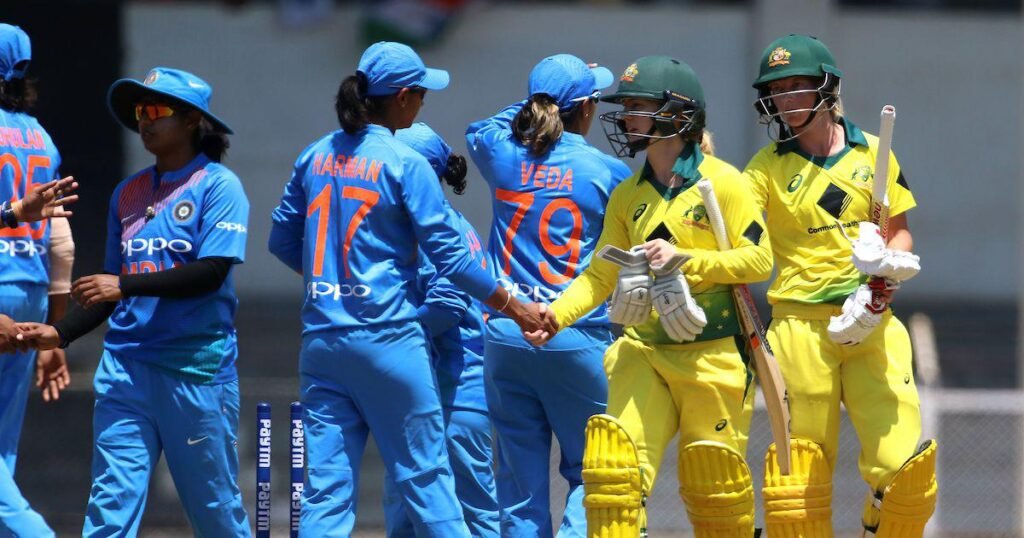

There are few rivalries in world sport that encompass the same emotional significance, historical context and modern-day excitement as Australia women’s national cricket team vs Indian women’s national cricket team timeline rivalry. From a one-sided contest comprising an established cricketing powerhouse and a developing nation, it has grown into one of the fiercest rivalries in the women’s game.
This cricket rivalry between the two nations has a history of over forty years, in terms of Test matches, One Day Internationals (ODIs) and T20 Internationals. It has generated iconic individual performances, record-breaking instances, and landmark wins that have irrevocably changed the global perception of women’s cricket. Following the history between the Australia women’s national cricket team and India women’s national cricket team is to follow an elemental journey of our times from a sport that had been niche to one celebrated across continents with raucous crowds filling cinemas.
This article chronicles the full journey: from Australia’s dominance in the early eras, India’s growing stature through sheer determination and talent to the current-day rivalry that holds a cricketing world spellbound.
Australia Women’s National Cricket Team vs India Women’s National Cricket Team Timeline
| Year | Key Event | Why It Matters |
| 1976–77 | First Women’s Test between Australia and India | Beginning of the historic rivalry. |
| 1997 | Belinda Clark scored 229* in the World Cup | First double century in ODI history. |
| 2005 | India won their first Women’s Test series vs Australia | Historic breakthrough for India. |
| 2017 | Harmanpreet Kaur’s 171* led India to World Cup semi-final victory | India’s most iconic win over Australia. |
| 2020 | Australia beat India in the Women’s T20 World Cup Final | Record crowd at the MCG. |
| 2021 | India ended Australia’s 26-match ODI winning streak | Showed India’s rise as a top contender. |
| 2023 | India recorded their first-ever Women’s Test win over Australia | Ended a 47-year wait. |
| 2024 | Australia won the ICC Women’s Championship ODI series | Continued the intense rivalry. |
| 2025 | India knocked Australia out of the Women’s World Cup semi-final | Highest successful chase in a Women’s World Cup knockout match. |
The Origins: First Meeting and Early Encounters (1976–1990s)
The official timeline for the India women’s cricket team against Australia started when they made their first trip to Australia and played a single Test match in Perth during 1976–77. It marked the start of a relationship that, in those very early years, was almost entirely defined by Australian superiority.
Back then, Australia was years ahead of the rest of women’s cricket. They established the gold standard of the women’s game when they went on to win the ICC Women’s ODI World Cup in 1978, 1982 and 1988. India’s cricket infrastructure was still in its infancy, with true trailblazers such as the likes of Shantha Rangaswamy and Diana Edulji showing great heart with scant resources.
The AUS vs IND head-to-head record was extremely one-sided in ODIs during this period. During the initial years of the rivalry, Australia’s strength as a cricketing nation due to its depth of talent, comprehensive professional structures and competitive domestic cricket gave them a distinct advantage India simply could not compete with.
But during those years of competitive loss, India fought with its head up. The seeds of one of cricket’s great rivalries were silently being sown defiance, determination, an unquenchable thirst for equity.
The 1990s: Belinda Clark and Australian Dominance
Much like the men’s game, Australia’s domination made it a hopeless landscape of women’s cricket in the 1990s. Especially in the Aus vs IND rivalry, no single performance from this epoch stands taller than Belinda Clark’s unreal 229 not out at the Mumbai 1997 cricket World Cup, it represented the first double hundred by any player (male or female) in ODI history.
These Stats Are Not Just For Records, Its A Statement: CLark In that phrase it topped a yawning chasm between what Australia was and the rest of the world. It was a sobering kick in the pompoms for India, on home soil.
The Australian domestic structure, and the Women’s National Cricket League (WNCL), which started in 1996–97 was churning out quality cricketers at a level no other country could approach. All of a sudden, fast bowler Cathryn Fitzpatrick arrived as a genuinely world class operator and Australia cruised through that 1997 World Cup with the sort of ruthless efficiency which left India in their wake in the group stage en route to lift the trophy.
In this period, the Australia vs India women ODI head to head as far as 4-7 series wise record is re-evolving in its narration. However, as we have come to learn, when it comes to history, there are always more chapters.
The 2000s: A Watershed Moment and India’s First Stirrings
It was the 2000s when the timeline of India women’s national cricket team vs Australia women’s national cricket team really changed. The Indian women had started to get more institutional support, and a new generation of talent came along to really make up for the lost time and upset the status quo.
At the heart of India’s ascension was Mithali Raj widely considered as the best batter this country had ever produced in women’s cricket. Mithali would eventually go on to score 1,123 runs against Australia in ODI, more than any other Indian batter against this opponent. Her solidity, her calmness under pressure and the fact that she had played for so long gave India a focal point to build around.
The first really marking point of India’s resistance in this rivalry came in the form of 2005; India secured its first series win against Australia in Women’s Tests. That was a landmark result proof that the stranglehold Australia had over this rivalry could be broken. That victory in the series did not instantly lead to lasting success, but it planted a seed of belief that would bloom spectacularly over the coming years.
Meanwhile on the other side of the world, Ellyse Perry was emerging as a generational all-round talent. His impact with bat and ball across generations of Australian cricket would go on to be one of the defining lines that defined entire chapters of that rivalry from as early as the mid-2000s, all the way into the 2020s.
Also read this: Where to Watch India vs New Zealand | Orange Cap IPL 2026 | India vs Pakistan Live
Watch Live T20I & ODI Free Channels
| Country/Region | TV Channel | Live Streaming Platform | Free/Paid |
|---|---|---|---|
| India | Sports18 / Star Sports* | JioHotstar* | Paid (Free for select matches/offers) |
| Australia | Fox Cricket | Kayo Sports | Paid |
| United Kingdom | Sky Sports Cricket | Sky Go / NOW | Paid |
| United States & Canada | Willow TV | Willow TV App | Paid |
| South Africa | SuperSport Cricket | SuperSport App | Paid |
| New Zealand | Sky Sport NZ | Sky Sport Now | Paid |
| Pakistan | PTV Sports / A Sports* | Tamasha App* | Free (selected matches) |
| Worldwide | ICC.tv (selected regions) | ICC.tv | Free (where broadcasting rights are unavailable) |
The 2010s: India Finds Its Voice
It was the second decade of the 21st century which saw the AUS vs IND women’s cricket rivalry breath life as a contest between near equals. India’s long-term investment in the domestic game finally seemed to be bearing fruit, with a new generation of players coming through Harmanpreet Kaur, Smriti Mandhana, Jhulan Goswami but also for Deepti Sharma they could match anyone in the world.
The most iconic moment of the decade perhaps in the entire history of the women’s cricket rivalry between these two nations came at the semi-final of 2017 Women’s Cricket World Cup. India confronted Australia at Derby, and some had the best possible all-out hopes of the Indians. The sequence that followed was one of the finest individual batting displays ever in the game.
‘Not out’, ‘aggressive’, & ‘brutal’: Harmanpreet Kaur’s 171 sent Australia packing and Indian women’s cricket into the realm of public attention. It was more than a match winner, it was a cultural moment of the innings. This time in just the space of a night, millions of Indian fans who had never before tuned into women’s cricket fell for it.
The entire narrative around the rivalry was flipped on its head by the 2017 World Cup semi-final. India could not be considered a mere underdog any more; India was now a real threat. That day, Harmanpreet’s innings against Australia was not just one of the biggest classics in ODI women’s cricket history but fired a generation of Indian girls who wished to don the blue jersey.
On the other hand during the 2020 Women’s T20 World Cup in Australia, they faced off against each other at Melbourne Cricket Ground, where a record-breaking 86,174 folks, the highest attendance for any women’s cricket game ever, gathered to witness their grand showdown. Australia played very well too but the troughs and peaks that were shown right there in that final plus the crowds, size of it all, intensity of it all told everyone that women’s cricket was a proper sport now.
2021–2022: Australia’s Dominance and a Record ODI Streak
Going into India’s 2021–22 tour of Australia, the Australians had accomplished one of the most improbable and record-breaking winning streaks in cricket history a world-record egalitarian melding to Ricky Ponting’s Australian men’s team resin: 26 ODIs consecutively. It was India who finally halted that run, claiming an ODI at Queensland in a nail-biter on the final ball which had witnesses erupting with joy from their ranks
The third ODI win was illustrative of the changed equation between two cricketing powerhouses within that narrative: Australia in the ascendancy for a major part of play, and India capable of creating an upset on any day. By the end of 2025, the head to head record in ODI between Australia and India still heavily favoured the former although out of 61 ODI meetings, Australia had won 48 to India’s 12 but increasingly the numbers did not tell just how competitive modern battles have become.
December 2023: India’s Historic First Test Win
History: India in fact had never won a Women’s Test against Australia since the dawn of time – well, for over 40 years. In a sight that will be imprinted in the annals of time for the Australia women’s national cricket team vs India women’s national cricket team rivalry, that astounding statistic lasted until December 2023 in Mumbai.
India opted to bat first and scored a mammoth 406 in their opening innings. Next, one of the most underrated players in world cricket: Deepti Sharma bowled a mesmerizing spell and picked up 5 wickets for 38 runs British women scalping Australia. In the wake of India, whom millions at home and in the dressing room congratulated as though winning. It was a historical victory, but it isn’t necessarily a win for the World Cup itself when only eight wickets remain to chase 75 in their second innings.
While the result of the 2023 Test in Mumbai was more than just a blip. It was a statement: India had bridged the gap in all formats. The women that had grown up wanting to be like Mithali Raj and drawn inspiration from Harmanpreet’s heroics of 2017, had now just accomplished what no Indian women’s cricket team managed in its chequered history of 40 years. Having beaten South Africa 2-1 in the Test series that preceded these ODIs and T20s, India backed this performance up with competitive efforts to illustrate there was no fluke here.
2024–2025: A Rivalry at Its Peak
December, 2024: India toured Australia for a three-match ODI series as part of ICC Women’s Championship here. The series took place alongside a men’s Test series between the two countries, producing an unusual dual focus on the tour and creating unprecedented media attention for the women’s game. Australia won the three-match series at home – played in Brisbane and Perth — but only after India contested every match robustly.
The most notable statistical event in the rivalry during this phase occurred in September 2025 when Australia was touring India to play an ODI series of three matches. In that series, one match had the highest aggregate runs in women’s ODI history 781 total runs which broke the previous record of 678 between England and South Africa in 2017.
It was also the day that Harmanpreet Kaur scored her 8,000th run in international cricket and Megan Schutt secured her 300th which combined with one incredible afternoon for person bests produced the kind of quality and intensity this series now consistently delivers.
Then came the point, perhaps the most emblematic of just how much power in this rivalry has shifted.
India vs Australia, 2025 Women’s Cricket World Cup semi-final (Knockout match of the highest stakes) Australia scored a mammoth total of what looked like 338 runs. To complete the highest successful chase in Women’s World Cup knockout history, India had to respond, and they did not flinch. With Jemimah Rodrigues scoring a splendid 127 not out, India chased down the total in remarkable style by 5 wickets knocking Australia from the tournament and earning their place to face South Africa in the final.
It brought to an end Australia’s 44-match unbeaten run in the ODI World Cup and sent shockwaves around the cricket world. Jemimah Rodrigues’s 127 not out in the 2025 World Cup semi-final ranks alongside Harmanpreet’s 171 from the same stage of the tournament in 2017 among all-time great innings this rivalry has seen.
Key Statistics: AUS vs IND Women’s Cricket Head to Head
| Format | Matches | Australia Wins | India Wins | No Result |
| ODI (to end 2025) | 61 | 48 | 12 | 1 |
| Women’s Test | Multiple | Dominant | 1 (2023) | Several draws |
| T20 International | Multiple | Majority | Several | — |
Top performers in the rivalry:
- Mithali Raj — 1,123 ODI runs against Australia (India record)
- Harmanpreet Kaur — 171* (2017 WC semi-final); 8,000th international run (2025)
- Deepti Sharma — 5/38 in historic 2023 Mumbai Test
- Jemimah Rodrigues — 127* (2025 WC semi-final)
- Ellyse Perry — Defining all-round presence across multiple generations
- Megan Schutt — 300th international wicket (2025)
- Belinda Clark — 229* (1997 World Cup, Mumbai)
CONCLUSION
The Australia Women’s National Cricket Team vs India Women’s National Cricket Team Timeline is an epic tale of two nations, two beliefs in the game and one incredible journey towards equality on the pitch. And the stats, through decades of history against Australia 48 wins to 12 in ODIs. But statistics, as this rivalry has shown many times before, can only tell so much of the story.
They might vicariously find out that Harmanpreet did not play lofted strokes for the first 30 balls, but cannot record the sight of her bat slicing through Derby evening air in 2017. They cannot quantify the elation of India’s dressing room in December 2023, when four decades worth of Test match anguish was finally obliterated. You couldn’t quantify the roar of explosion when Jemimah Rodrigues hit the winning runs in the 2025 World Cup semi-final.
The battle between India women and Australia women has blossomed into one of the marquee contests in world sport, a match-up where tradition meets modernity, stats meet emotion and dominance meets defiance. Australia remains the most successful women’s cricket team ever in history, the gold standard to which all other teams are measured. But India has made it clear, in no uncertain terms and time after time that they are at the highest level.
This is still an ongoing rivalry in the history of women’s cricket Scorecard And if history is anything to go by, it could turn out to be even more extraordinary than everything else that has preceded it.
FAQs
1. When did the Australia Women’s National Cricket Team first play against the India Women’s National Cricket Team?
The two teams first met in the 1976–77 Women’s Test series in Perth, marking the beginning of one of the longest-running rivalries in women’s international cricket.
2. What is the biggest moment in the Australia Women’s National Cricket Team vs India Women’s National Cricket Team timeline?
One of the biggest moments came in the 2017 ICC Women’s World Cup semi-final, when Harmanpreet Kaur’s unbeaten 171 guided India to a famous victory over Australia.
3. Has the India Women’s National Cricket Team ever defeated Australia in a Women’s Test match?
Yes. India recorded its first-ever Women’s Test victory over Australia in December 2023 at Mumbai, ending a wait of more than four decades.
4. Who has scored the most memorable innings in the Australia Women’s National Cricket Team vs India Women’s National Cricket Team rivalry?
Some of the most iconic innings include Belinda Clark’s 229* in 1997, Harmanpreet Kaur’s 171* in 2017, and Jemimah Rodrigues’ 127* in the 2025 Women’s World Cup semi-final.
5. What is the head-to-head record between Australia Women and India Women in international cricket?
Australia holds the overall advantage across Tests, ODIs, and T20Is. However, India has become a much stronger competitor in recent years with several memorable victories in major ICC tournaments.
6. Why is the Australia Women’s National Cricket Team vs India Women’s National Cricket Team rivalry so popular?
The rivalry is popular because it features world-class players, thrilling ICC tournament matches, historic records, and intense competition between two of the strongest teams in women’s cricket.