
India Women vs England Women T20, perhaps very few contests fire up to excitement like India Women vs England women in T20 half. A duo of the form very best bowling line-ups, a history of run-flinging shootouts and a summer of 2026 that repeatedly has placed their two sides together in a series bilateral at first, then entirely across the group and knockout levels of the ICC Women’s T20 World Cup this has created might close to as attention-grabbing a rivalry like anything else on earth cricket.
Here is a detailed overview of the way the India-England T20 narrative has played out thus far this year, who are the players shaping it and what lies ahead for both teams.
create table on “India Women vs England Women T20”
India Women vs England Women T20 Series 2026 Results
| Match | Venue | Winner | Margin | Player of the Match | Key Highlight |
| 1st T20I | Chelmsford | India Women | 38 Runs | Jemimah Rodrigues | Jemimah scored a blistering 69 off 40 balls, while Shafali Verma added 51 to help India post a commanding total. |
| 2nd T20I | Bristol | England Women | Won by successful chase | England middle order | England bounced back with a strong fourth-wicket partnership to level the three-match series 1-1. |
| 3rd T20I | Taunton | England Women | Won by successful chase | Alice Capsey / Heather Knight (key contributors) | England chased down India’s 180-run target to seal the series 2-1 with impressive batting performances. |
India Women vs England Women T20 Series Summary
| Category | Details |
| Series | India Women Tour of England 2026 (T20I Series) |
| Format | Women’s T20 International |
| Total Matches | 3 |
| Series Result | England Women won the series 2-1 |
| India Captain | Harmanpreet Kaur |
| England Captain | Nat Sciver-Brunt |
| Highest Impact Batter (India) | Jemimah Rodrigues |
| Highest Impact Batter (England) | Danni Wyatt-Hodge |
| Leading India Bowler | Deepti Sharma |
| Leading England Bowler | Sophie Ecclestone |
| Biggest Talking Point | England recovered from 0-1 down to win the series 2-1 before the ICC Women’s T20 World Cup 2026. |
A Rivalry Built on Contrasting Strengths
That is part of the reason why meetings between India Women and England Women are among the best watches, they come from very different traditions in T20 cricket. The foundation of India’s batting is with their middle-order stroke-makers, and two or three overs from smashers like Jemimah Rodrigues and Richa Ghosh can decide a contest. They have long based their white-ball success around a spin-bowling depth led by Deepti Sharma, Shreyanka Patil and Radha Yadav.
Meanwhile, England have favoured top order scoring. Nat Sciver-Brunt returns boosted by in-form opener Danni Wyatt-Hodge and classy Sophia Dunkley as their opening and middle order continue to deliver across global tournaments with one of the highest run rates. The impact of Sophie Ecclestone as the anchor with Charlie Dean to perform second fiddle and dominate bat first, defend world-class spin means that England are a very single-minded outfit who have become one of the most consistent white-ball sides in the last five years.
During the clash of these two styles, matches often turn late and it has been no different in 2026.
The May-June 2026 Bilateral T20I Series
The final training assignment of the two at the prerequisite preparation before Women’s T20 World Cup started Off with a three- match T20I seriesIn England Tour Of India, Women. The series was of added importance as India entered the ICC Women’s T20I standings at No 3 and hosts England second, making every match pushed Seeding on the road to the global event.
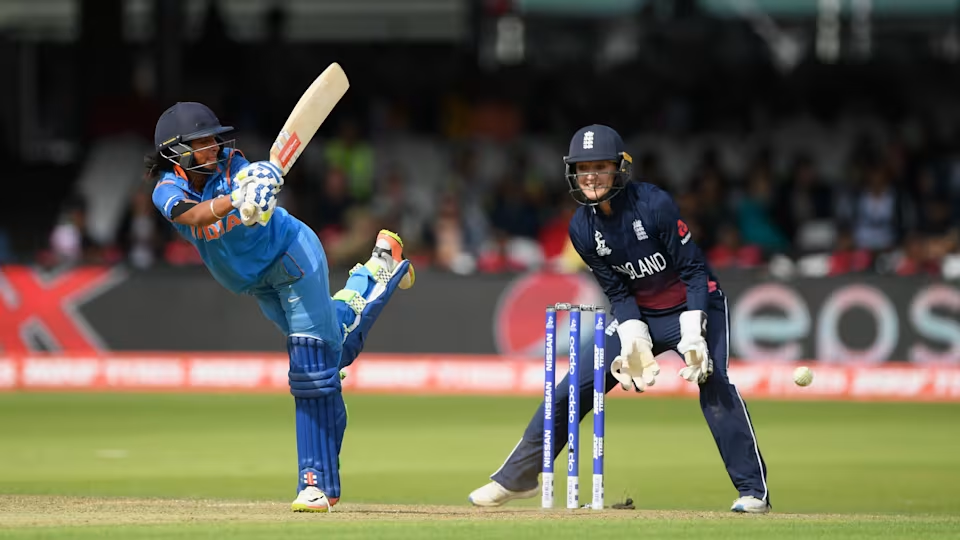
First T20I, Chelmsford: After winning the toss and electing to bat first, India’s batsmen laid a great platform with Jemimah Rodrigues leading the charge with an explosive 69 off 40 deliveries (4 fours, 5 sixes) in their tour opener followed by Shafali Verma’s innings of 51 runs.
With the help of all those efforts put together India managed to set a score big enough for victory with Jemimah winning Player of the Match award Yastika Bhatia, playing just her second game since returning from an ACL injury and replacing a struggling Pooja Vastrakar in the middle-order, complemented her with a solid fifty.
Second T20I, Bristol: Under-renovated and unable to capitalise on good starts, the England batters could only complete 150-41 as India won the first match of the series by 38 runs with a chase of 189. India had been in commanding position on the day, particularly after England’s top-order made a decisive win over New Zealand last series and it was particularly encouraging for India’s bowling attack — as historically criticized needing confidence boost.
England’s response was precisely what you would expect of a major tournament challenger. Match report Second T20I, Bristol An “imposing fourth-wicket partnership” helped to chase down what had seemed to be a defend-able target, as the middle order cruised through the required run rate.
The victory gave the hosts the second match in one to tie the series (1-1), handily reclaiming all momentum ahead of the winner-takes-all decider. England are already settled in their batting lineup but allrounder Freya Kemp, returning from a long layoff back injury, has shown more depth with her performances.
Third T20I, Taunton: As it turned out the series finale lived up to its billing as a shootout. A total that seemed decent on paper, India scored 180, with England romping to victory: contributions from Alice Capsey and Heather Knight credited by some as a foundation for the World Cup ultimate this summer as the hosts came back in the series.
It said as much over England’s strength in depth but also showed their intent to close out the tour 2-1 after trailing 0-1, with constant messages throughout by head coach and captain that fringe players were desperate to impress for final World Cup squad places.
While results were one thing the series was perfect for a dress rehearsal. India rotated their combinations through the games, one of which was Nandani Sharma who made her international debut after a prolific domestic season while easing seam bowlers Renuka Singh Thakur, Kranti Goud and Arundhati Reddy into match practice.
For England, the series acted as a stress test for their top three, with captain Nat Sciver-Brunt able to get back from injury and promising players such as Em Arlott being given game time.
Squads That Shaped the Series
India’s squad for the England challenge had a mix of youth and experience: Harmanpreet Kaur (c), Smriti Mandhana (VC); Shafali Verma, Jemimah Rodrigues, Deepti Sharma, Richa Ghosh, Yastika Bhatia, Shree Charani Nandani Sharma, Arundhati Reddy Renuka Singh Kranti Goud Shreyanka Patil Radha Yadav. Bhatia’s and Yadav’s returns from injury lay-offs were also seen as a boon for India, giving the team management more of an idea about their strongest XI heading into the World Cup.
With Tammy Beaumont, Lauren Bell, Alice Capsey, Charlie Dean, Sophia Dunkley, Sophie Ecclestone and Lauren Filer; Amy Jones and Nat Sciver-Brunt and Danni Wyatt-Hodge; and Issy Wong all playing for the team they so dearly longed to be part of again it was a cricketing riddle that provided Charlotte Edwards with a rather meaningful selection conundrum — one deemed at various points during last week as good headaches to have.
A Warm-Up Skirmish Before the Main Event
The two teams also faced each other again in a warm-up fixture at Sophia Gardens, Cardiff before the World Cup itself got underway. England batted first, scoring well on contributions from Amy Jones and Nat Sciver-Brunt, both with 55-65 runs at a breakneck clip. A fiery knock of 68 off 36 balls from wicketkeeper-batter Richa Ghosh gave India a glimmer of hope in their chase but with the required rate rising steeply, India lost by five runs.
It meant little in terms of points but it was yet another indicator that England batting began to peak at precisely the right time.
Diverging Paths at the Women’s T20 World Cup
This is where the India-England tale takes an unexpected turn. While their anticipated realistic repetition through the tournament was set up by quite a bit of the bilateral series and a warm up match, the Women’s T20 World Cup 2026 draw ensured they wouldn’t meet each other in the group stage: India were represented in Group 1 alongside Australia, South Africa, Pakistan, Bangladesh and Netherlands; while hosts England filled out Group 2 with West Indies, Sri Lanka, Scotland and Ireland.
The campaign started with comprehensive wins over Pakistan and Netherlands before a loss against South Africa owing to Simon Harmer’s unbeaten half-century in the magnum opus but it turned out a rather significant wrench in their works – somewhere between this period Marizanne Kapp too chipped-in affecting both batting units.
A second victory against Bangladesh kept the dream alive, however a nerve-jangling final group match defeat to Australia (who had completed the highest run-chase total in history when they chased down 385 to win with six wickets remaining) ensured India finished third in Group 1 and exited at the first hurdle.
England, conversely, were the former side of the competition. The reigning champions secured their spot in the last four earlier this week, winning all five of their group fixtures including a statement victory by 38 runs against West Indies and a commanding nine-wicket success over New Zealand to complete an unbeaten group stage campaign.
The top three batters of their side managed to score around nine per over throughout the group stage, comfortably the best at the competition, with Danni Wyatt-Hodge in particularly destructive form. That set up a semi against South Africa at The Oval, a repeat of previous one-day knockout clashes between the two nations, and Australia took on West Indies in the other semi.
The game itself never took place, however, with India’s elimination courtesy of the Netherlands coming before the knockouts, missing a potentially blockbuster World Cup clash between India and England; leaving things equal in terms of T20 face-offs between the two teams 1-1 through bilateral series after 2026. This is a reminder of how tournament draws really do sometimes screw fans out of a rematch, especially when it happens right after two teams have spent the prior weeks creating some real rivalry heat on the field.
Also read this: How Many Times Australia Women Won T20 World Cup | Women T20 World Cup Squad 2026
Key Performers Worth Following
Jemimah Rodrigues (India): Her match winning 69 in the series opener at Chelmsford was a reminder of her ability to accelerate through the middle overs, an area India have leaned on heavily in the T20 format.
Yastika Bhatia (India): Her return from an ACL injury was one of the feel-good stories of India’s tour, and her contribution alongside Rodrigues in the series opener suggested she remains India’s first-choice option behind the stumps.
Richa Ghosh (India): Even in defeat during the World Cup warm-up match, her 68 off 36 balls underlined why she remains one of the most feared finishers in the world game.
Nat Sciver-Brunt (England): Her return from injury and subsequent half-century in the World Cup warm-up match showed she remains central to England’s top-order plans, both as batter and captain.
Danni Wyatt-Hodge (England): Arguably the form batter of the England group-stage campaign, setting the tone at the top of the order and driving the best top-three run rate at the tournament.
Sophie Ecclestone (England): England’s premier spinner continues to be the axis around which their bowling plans revolve, and her performances across the series and tournament reinforced her status as one of the format’s most difficult bowlers to face.
Why This Rivalry Resonates Beyond the Scoreline
The wider context that both boards have built around their women’s programmes in recent years is part of the reason why India Women vs England Women has been so compelling to watch. BCCI’s sustained efforts in the Women’s Premier League are also clearly showing behind the scenes with players like Nandani Sharma, Yastika Bhatia arriving footsteps away from international cricket battle-hardened against high-end competition instead of being plonked there post little exposure.
What it shows is that the middle order of India has become more immune to pressure in close run-chases, although the final touch still eludes them against top quality sides, just as it had with South Africa and Australia in the World Cup.
In hindsight England’s depth is unsurprising, a product of years of central contracts and a domestic hierarchy centred around The Hundred and the regional franchise system that has ushered players like Alice Capsey and Freya Kemp into senior international cricket while still in their teens. The result, then, is a side that scarcely misses a beat even when key figures such as Nat Sciver-Brunt are unavailable in a part of the series through injury – something not every team in world cricket can currently boast.
And this is exactly why the series of India and England matches lately caught the attention of neutral fans. Both sides are not solely dependent on one or two match-winners; contributions have been made through the order from both batting orders, and across both bowling attacks, partly why margins in these matches have so often come down to fine details: a dropped catch, a mistimed final over or even a batter reaching for the gap at just the right moment.
Head-to-Head Context Heading Into the Summer
It was another in a long line of challenges between England and India at T20 internationals, where the former have historically enjoyed the better overall stats, as they did again recently in the last bilateral series when the hosts came from 0-1 down to clinch the tour 2-1. That head-to-head supremacy has been largely based on the strength of England’s top-order consistency and its defensive functionality being underpinned by world-class spin bowling, a blueprint that was clearly visible again in their unbeaten run through the World Cup group stage.
However, for India that gap was still a work in progress to close. The series in England shed glimmers of what the side is capable of when their middle order fires, as it did in the tour opener at Chelmsford; but also highlighted how slender the margins still are between the two sides when pressure ramps up, be that during the T20I final in Taunton and then later again in their tournament defeats to South Africa and Australia.
While results have not yet echoed it, several of India’s newer faces from the bowling of Nandani Sharma to the calm hand behind the stumps in Yastika Bhatia promise that while India still have work to do, they are beginning to close an ever-widening chasm.
What Comes Next
They will face off for the last time this season in a historic one-off Test at Lord’s in July 2026 — the first-ever women’s Test between the two countries to take place at that venue, on a weekend when England and India men meet seven miles away. Though being played in the format’s longest form as opposed to T20s, that fixture will provide an appropriate coda to a summer dominated by India and England meeting time and again across formats.
But for fans of white-ball cricket, the tale of India Women vs England Women in T20 cricket in 2026 would be remembered as yet another low-scoring bilateral series that swung on fine margins both times in Bristol and Taunton, the near-miss warm up thriller in Cardiff and the contrasting fortunes that followed at World Cup England posting a semi-final qualification ahead undefeated status while India’s campaign ended bei ng an agonizing failure to achieve top-four finish.
This rivalry is still defined as much by depth of squad and bench quality at the minute (two players repetitively leaving Cricket to focus elsewhere) staved it off on this occasion, with both boards having invested heavily in their women’s programmes so further instalments of this contest look pretty likely to come next year.
Final Word
It’s not only the head-to-head numbers which have made the India Women vs England Women T20 rivalry so exciting, but also how both sides have treated every encounter like another cog in their very real attempts to reach greater objectives be it a tour game against an ECB development side or a World Cup warm-up match. India will try to sort out the finishing troubles that hurt against Australia and South Africa in World Cup while England, after failing to qualify from the group stage in shock fashion, will hope their pool form carries over into knockout round success.
Either way, whenever these two sides next meet on the field it will likely be another closely fought contest that more than lives up to the growing reputation of this rivalry.
Also read this: Australia Women vs England Women Final Pitch Report Today
FAQs
Q1. Who won the India Women vs England Women T20 series 2026?
England Women won the three-match T20I series 2–1 after recovering from a 0–1 deficit. The hosts claimed victories in Bristol and Taunton to secure the series.
Q2. Where was the India Women vs England Women T20 series played?
The series was played at Chelmsford, Bristol, and Taunton in England as part of both teams’ preparations for the ICC Women’s T20 World Cup 2026.
Q3. Who was India’s best performer in the India Women vs England Women T20 series?
Jemimah Rodrigues was India’s standout performer. She scored a brilliant 69 off 40 balls in the opening T20I and played a key role in India’s victory.
Q4. How did England Women come back to win the T20 series?
After losing the first match, England responded with strong batting performances and disciplined bowling. They successfully chased targets in the second and third T20Is to win the series 2–1.
Q5. Did India Women and England Women face each other in the ICC Women’s T20 World Cup 2026?
No. Although both teams played a warm-up match before the tournament, they were placed in different groups and did not meet during the ICC Women’s T20 World Cup 2026.
Q6. Why is the India Women vs England Women T20 rivalry so popular?
The rivalry is one of the most exciting in women’s cricket because both teams feature world-class players, competitive batting line-ups, and quality spin attacks. Their matches are often closely contested and decided in the final overs.