
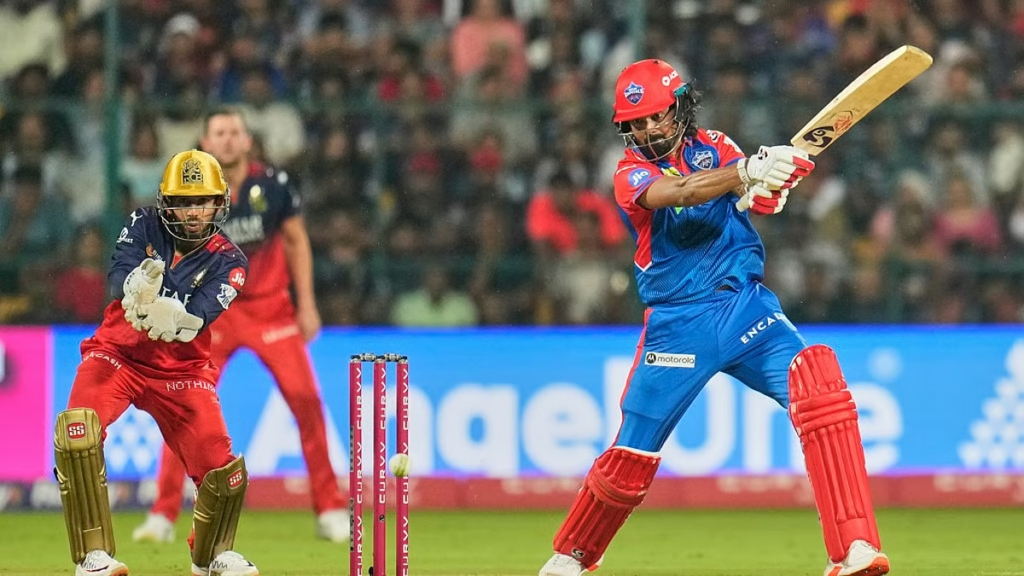

The Delhi Capitals vs Royal Challengers Bengaluru Match Scoreboard from IPL 2026 tells the story of one of the most one-sided games between the two sides in recent seasons. Royal Challengers Bengaluru produced a superb bowling performance at the Arun Jaitley Stadium on April 27, 2026, bowling Delhi Capitals out for just 75 runs in 16.3 overs before chasing the target in only 6.3 overs.
RCB won the match by 9 wickets, with Josh Hazlewood leading the destruction with an outstanding 4/12. Bhuvneshwar Kumar also played a major role with 3/5, while Devdutt Padikkal finished the chase unbeaten on 34 off 13 balls. Virat Kohli remained unbeaten on 23 from 15 balls.
For Delhi Capitals, Abishek Porel was the only batter to offer meaningful resistance, scoring 30 off 33 balls. David Miller added 19 and Kyle Jamieson made 12, but regular wickets prevented DC from building any substantial partnership.
This article covers the complete DC vs RCB match scorecard, including both innings, batting and bowling figures, fall of wickets, partnerships, key moments, player performances, match statistics, head-to-head record and frequently asked questions.
Delhi Capitals vs Royal Challengers Bengaluru Match Scorecard
The 39th match of the Indian Premier League 2026 was played at the Arun Jaitley Stadium in Delhi on April 27. Royal Challengers Bengaluru won the toss and decided to bowl first.
That decision quickly proved to be the right one. RCB’s new-ball attack dismantled the Delhi Capitals batting order, and DC struggled to score freely throughout their innings.
Delhi Capitals were eventually dismissed for 75 runs in 16.3 overs, giving RCB a modest target of 76.
RCB then made extremely light work of the chase. Jacob Bethell scored 20 from 11 balls before being dismissed, but Virat Kohli and Devdutt Padikkal ensured there was no further drama. RCB reached 77/1 in 6.3 overs to complete a nine-wicket victory.
Quick Match Summary
| Details | Information |
| Match | Delhi Capitals vs Royal Challengers Bengaluru |
| Competition | Indian Premier League 2026 |
| Match Number | Match 39 |
| Date | April 27, 2026 |
| Venue | Arun Jaitley Stadium, Delhi |
| Toss | Royal Challengers Bengaluru |
| Toss Decision | Bowled first |
| Delhi Capitals | 75 all out |
| DC Overs | 16.3 |
| Royal Challengers Bengaluru | 77/1 |
| RCB Overs | 6.3 |
| Result | RCB won by 9 wickets |
| Player of the Match | Josh Hazlewood |
| Best Bowling | Josh Hazlewood 4/12 |
| Highest DC Scorer | Abishek Porel, 30 |
| Highest RCB Scorer | Devdutt Padikkal, 34* |
The official match listings confirm the venue, toss, final scores and nine-wicket result, while the scorecard records Hazlewood as Player of the Match for his four-wicket spell.
Also read this: Kolkata Knight Riders vs Punjab Kings Timeline | Kolkata Knight Riders vs Delhi Capitals Match Scorecard | Sunrisers Hyderabad vs Delhi Capitals Timeline
Delhi Capitals vs Royal Challengers Bengaluru Full Scorecard
The first innings became the defining part of the match. Delhi Capitals lost wickets at regular intervals and never managed to establish control.
RCB’s fast bowlers were particularly effective. Bhuvneshwar Kumar opened the attack with a highly economical spell, while Josh Hazlewood repeatedly found breakthroughs.
Delhi Capitals Batting Scorecard
| Batter | R | B | 4s | 6s | SR |
| Sahil Parakh | 0 | 2 | 0 | 0 | 0.00 |
| KL Rahul | 1 | 3 | 0 | 0 | 33.33 |
| Nitish Rana | 1 | 9 | 0 | 0 | 11.11 |
| Sameer Rizvi | 0 | 1 | 0 | 0 | 0.00 |
| Tristan Stubbs | 5 | 3 | 1 | 0 | 166.67 |
| Axar Patel | 0 | 3 | 0 | 0 | 0.00 |
| Abishek Porel | 30 | 33 | 3 | 0 | 90.91 |
| David Miller | 19 | 18 | 3 | 0 | 105.56 |
| Kyle Jamieson | 12 | 13 | 1 | 1 | 92.31 |
| Kuldeep Yadav | 3 | 11 | 0 | 0 | 27.27 |
| Dushmantha Chameera | 0* | 3 | 0 | 0 | 0.00 |
| T. Natarajan | Did not bat | — | — | — | — |
| Extras | 4 | ||||
| Total | 75 all out | 16.3 ov |
The scorecard shows just how difficult the innings was for Delhi. Porel’s 30 was the highest score, while Miller’s 19 and Jamieson’s 12 were the only other contributions above ten.
Opening Partnership
There was almost no opening partnership to speak of.
Sahil Parakh was dismissed for a duck from only two deliveries, while KL Rahul fell for one shortly afterwards. The early wickets immediately placed Delhi under pressure.
RCB’s bowlers kept attacking the stumps and forced the DC batters to play under pressure. The score was only 7/5 after 2.4 overs, a devastating start that effectively decided the contest.
Middle-Order Performance
Delhi’s middle order could not recover from the early collapse.
Nitish Rana scored only one from nine balls, Sameer Rizvi departed without scoring, Tristan Stubbs made a quick five, and Axar Patel was dismissed for a duck.
Porel attempted to hold the innings together, but wickets continued to fall around him. Miller’s 19 provided some support, yet Delhi never reached a position from which a competitive total looked likely.
Top Scorer: Abishek Porel
Abishek Porel was the standout batter for Delhi Capitals.
His 30 off 33 balls included three fours and gave DC their only substantial individual contribution. He was eventually dismissed by Josh Hazlewood, bringing the innings to an end at 75.
Porel’s innings was not particularly fast, but considering the situation in which he batted, his effort was important. Without his contribution, Delhi could have been dismissed for an even smaller total.
Royal Challengers Bengaluru Bowling Scorecard
RCB’s bowling performance was the biggest reason for the result.
RCB Bowling Card
| Bowler | O | M | R | W | Econ |
| Bhuvneshwar Kumar | 3 | 0 | 5 | 3 | 1.67 |
| Josh Hazlewood | 3.3 | 0 | 12 | 4 | 3.64 |
| Rasikh Salam Dar | 2 | 0 | 21 | 1 | 10.50 |
| Romario Shepherd | 2 | 0 | 21 | 0 | 10.50 |
| Suyash Sharma | 4 | 1 | 7 | 1 | 1.75 |
| Krunal Pandya | 2 | 0 | 9 | 1 | 4.50 |
Hazlewood finished with 4/12 from 3.3 overs, while Bhuvneshwar Kumar returned remarkable figures of 3/5 from three overs. Suyash Sharma also contributed with 1/7 from four overs.
Leading Wicket-Taker
Josh Hazlewood was the leading wicket-taker with four wickets.
His spell was especially damaging because he removed important Delhi batters and prevented the innings from recovering. His figures of 4/12 earned him the Player of the Match award.
Most Economical Bowler
Bhuvneshwar Kumar produced the best economy rate among the regular bowlers.
He conceded only five runs in three overs while taking three wickets, giving him an economy rate of 1.67. Suyash Sharma was similarly impressive, conceding only seven runs from his four overs.
Death-Over Performance
RCB did not need to rely heavily on death-over bowling because Delhi’s innings had already collapsed before reaching the final overs.
Hazlewood completed his spell by taking the final wicket at 16.3 overs, dismissing Porel and ending Delhi’s innings at 75.
Royal Challengers Bengaluru Batting Scorecard
RCB’s chase was almost the exact opposite of Delhi’s innings.
The target was only 76, and RCB’s batters attacked from the beginning. Jacob Bethell provided a fast start before Kyle Jamieson dismissed him at 26/1.
After that, Virat Kohli and Devdutt Padikkal completed the chase with considerable ease.
RCB Batting Card
| Batter | R | B | 4s | 6s | SR |
| Jacob Bethell | 20 | 11 | 1 | 2 | 181.82 |
| Virat Kohli | 23* | 15 | 1 | 2 | 153.33 |
| Devdutt Padikkal | 34* | 13 | 3 | 3 | 261.54 |
| Rajat Patidar | Did not bat | — | — | — | — |
| Jitesh Sharma | Did not bat | — | — | — | — |
| Tim David | Did not bat | — | — | — | — |
| Romario Shepherd | Did not bat | — | — | — | — |
| Krunal Pandya | Did not bat | — | — | — | — |
| Bhuvneshwar Kumar | Did not bat | — | — | — | — |
| Josh Hazlewood | Did not bat | — | — | — | — |
| Suyash Sharma | Did not bat | — | — | — | — |
| Rasikh Salam Dar | Did not bat | — | — | — | — |
| Extras | 0 | ||||
| Total | 77/1 | 6.3 ov |
RCB’s chase required only 39 balls. Padikkal’s 34 not out from 13 balls was the highest score, while Kohli finished unbeaten on 23 from 15.
RCB Opening Partnership
Jacob Bethell and Virat Kohli started the chase aggressively.
Bethell scored 20 from 11 deliveries, including one four and two sixes. His strike rate of 181.82 immediately put pressure on Delhi’s bowlers.
He was eventually dismissed by Kyle Jamieson at 26/1 in the third over.
Devdutt Padikkal’s Explosive Finish
Devdutt Padikkal was the star of the chase.
He scored 34 not out from only 13 balls, hitting three fours and three sixes. His strike rate of 261.54 underlined the gulf between the two batting performances on the night.
Padikkal did not need to take unnecessary risks because the target was tiny, but he still attacked whenever the opportunity came.
Virat Kohli’s Contribution
Virat Kohli remained unbeaten on 23 from 15 balls, with one four and two sixes.
He played the perfect supporting role while Padikkal attacked from the other end. Kohli also reached the landmark of 9,000 IPL runs during the chase, adding another significant milestone to an already remarkable career.
Delhi Capitals Bowling Scorecard
Delhi’s bowlers had a very difficult task defending only 75.
DC Bowling Card
| Bowler | O | M | R | W | Econ |
| Kyle Jamieson | 3 | 0 | 42 | 1 | 14.00 |
| Dushmantha Chameera | 2 | 0 | 18 | 0 | 9.00 |
| Axar Patel | 1 | 0 | 5 | 0 | 5.00 |
| T. Natarajan | 0.3 | 0 | 12 | 0 | 24.00 |
Kyle Jamieson took the only RCB wicket, dismissing Jacob Bethell, but he conceded 42 runs in his three overs. T. Natarajan was particularly expensive, giving away 12 runs in only three deliveries as RCB closed out the chase.
Best DC Bowler
Kyle Jamieson was the only Delhi bowler to take a wicket.
He dismissed Bethell at 26/1, but his overall figures of 1/42 meant that he could not put sustained pressure on RCB.
Powerplay Bowling
Delhi struggled to contain RCB during the powerplay.
RCB reached 65/1 after six overs, leaving only 11 runs required from the final four deliveries.
That statistic tells the story better than almost anything else: the entire chase was effectively over inside the powerplay.
Delhi Capitals vs RCB Innings-Wise Score
| Team | Score | Overs | Result |
| Delhi Capitals | 75/10 | 16.3 | All out |
| Royal Challengers Bengaluru | 77/1 | 6.3 | Won by 9 wickets |
Delhi’s innings produced a run rate of only 4.55 runs per over, while RCB scored at 11.85 runs per over.
The difference was enormous.
Delhi needed to build a defendable total after losing early wickets, but their batting never recovered. RCB, meanwhile, had only a small target and could attack almost every delivery.
DC vs RCB Match Result
Royal Challengers Bengaluru defeated Delhi Capitals by nine wickets.
Delhi Capitals were bowled out for 75 in 16.3 overs. RCB chased the target of 76 by reaching 77/1 in just 6.3 overs.
The match was effectively decided during Delhi’s powerplay.
After losing five wickets for only seven runs, Delhi had little chance of posting a competitive score. The wickets kept coming, and although Porel and Miller provided some resistance, 75 was never going to be enough.
RCB then attacked the chase from the start. Bethell’s dismissal was the only moment that gave Delhi a chance, but Padikkal and Kohli removed any uncertainty.
The final margin of nine wickets reflected the dominance of RCB’s performance.
DC vs RCB Top Performers
Top Batter: Devdutt Padikkal
Devdutt Padikkal was the highest scorer for RCB with 34 not out from 13 balls.
His innings contained:
- 34 runs
- 13 balls
- 3 fours
- 3 sixes
- 261.54 strike rate
It was a short but extremely destructive innings and ensured that RCB completed the chase in minimal time.
Best Bowler: Josh Hazlewood
Josh Hazlewood was the outstanding bowler of the match.
His figures:
- 3.3 overs
- 12 runs
- 4 wickets
- 3.64 economy
He dismissed key Delhi batters and finished the innings by taking Porel’s wicket. His four-wicket haul earned him the Player of the Match award.
Player of the Match: Josh Hazlewood
Hazlewood’s spell was the defining performance of the game.
Taking four wickets while conceding only 12 runs meant that Delhi never got the opportunity to establish a competitive innings. Bhuvneshwar Kumar’s 3/5 made the bowling effort even more impressive.
Delhi Capitals Batting Performance
Delhi’s batting performance was the biggest disappointment of the evening.
Powerplay Collapse
The collapse began almost immediately.
Sahil Parakh was dismissed for a duck, KL Rahul followed for one, and Nitish Rana was unable to get going. Sameer Rizvi, Tristan Stubbs and Axar Patel then departed in quick succession.
At one point, Delhi were only 7/5, a score that left them fighting simply to avoid one of their lowest totals.
Middle Overs
Abishek Porel attempted to stabilize the innings.
He played a patient 30 from 33 balls and was the backbone of the DC batting card. David Miller’s 19 from 18 balls gave him some support, but their partnership could not take the innings anywhere near a competitive score.
Late Overs
Kyle Jamieson added 12 from 13 balls and gave Delhi a small late contribution.
However, wickets kept falling. Kuldeep Yadav was dismissed for three, while Porel was the final wicket to fall.
Delhi eventually ended on 75 all out.
Overall Assessment
The biggest problem was not simply the final score. It was the absence of a partnership.
A T20 innings can survive an early wicket, but losing five wickets for seven runs puts almost any team in an impossible situation.
Delhi needed one or two batters to play a long innings, but RCB’s bowling attack prevented that from happening.
Royal Challengers Bengaluru Batting Performance
RCB’s batting display was efficient and aggressive.
Powerplay
RCB scored 65/1 after six overs, needing only 11 more runs.
Bethell’s attacking start set the tone, while Padikkal took advantage of the pressure-free chase.
Middle Overs
There were no real middle overs in the conventional sense because RCB finished the chase at 6.3 overs.
Kohli and Padikkal remained unbeaten and completed the job before Delhi could introduce significant variations.
Finishing Performance
Padikkal finished the game in style.
With 34 from 13 balls, he ensured that RCB’s net run rate benefited substantially from the quick chase.
Kohli also added two sixes during the closing stages. His final two sixes against T. Natarajan took RCB over the line and provided a memorable ending.
DC vs RCB Bowling Performance
Delhi Capitals Bowling Analysis
Delhi’s bowlers had almost no margin for error because they were defending just 75.
Kyle Jamieson made the first breakthrough by dismissing Jacob Bethell, but the cost of his spell was high.
His 1/42 meant RCB were able to maintain an extremely high scoring rate.
Dushmantha Chameera conceded 18 from two overs, while T. Natarajan gave away 12 from 0.3 overs.
Axar Patel was the most economical DC bowler, conceding only five runs from his single over.
RCB Bowling Analysis
RCB’s bowling was the complete opposite.
Bhuvneshwar Kumar and Josh Hazlewood destroyed the top order, while Suyash Sharma and Krunal Pandya maintained pressure through the middle overs.
Bhuvneshwar’s 3/5 and Hazlewood’s 4/12 were the key figures.
The bowling unit also kept extras to just four runs, meaning Delhi had to generate almost every run from the bat.
Key Moments From Delhi Capitals vs RCB
RCB Choose to Bowl
Royal Challengers Bengaluru won the toss and elected to field.
On a surface where the new ball could offer some assistance, the decision gave RCB’s fast bowlers the opportunity to attack the Delhi top order. The official match data records RCB’s decision to bowl first.
Early Wickets
The first few overs completely changed the game.
Delhi lost KL Rahul, Sameer Rizvi, Tristan Stubbs, Axar Patel and Nitish Rana in a stunning sequence.
The score reached only 7/5, putting Delhi in survival mode.
Hazlewood’s Four-Wicket Spell
Hazlewood continued the pressure after the early damage.
He dismissed Rahul, Rana, Rizvi and Porel to finish with 4/12.
That spell ensured Delhi could not recover.
Porel’s Resistance
Porel’s 30 was the only substantial innings in the DC batting card.
His resistance helped Delhi reach 75, but it was nowhere near enough.
Bethell’s Quick Start
RCB did not waste time chasing the target.
Bethell scored 20 from 11 balls before falling at 26/1. His dismissal was the only wicket Delhi managed during the chase.
Padikkal Takes Control
Padikkal then took charge.
Three fours and three sixes in 13 balls ensured the chase accelerated rapidly.
Kohli Finishes the Match
Virat Kohli remained unbeaten and struck consecutive sixes off T. Natarajan in the sixth over. RCB moved from 65/1 to 77/1 and completed the chase at 6.3 overs.
DC vs RCB Partnership Highlights
| Team | Partnership | Runs | Wicket |
| Delhi Capitals | Abishek Porel – David Miller | Key recovery stand | 7th wicket |
| Royal Challengers Bengaluru | Virat Kohli – Devdutt Padikkal | 51* | 2nd wicket |
RCB’s unbeaten partnership between Kohli and Padikkal was the most important stand of the chase.
After Bethell was dismissed at 26/1, the pair scored the remaining 51 runs without losing another wicket.
For Delhi, Porel’s partnerships were more about damage control. The early collapse meant every run added after 7/5 had value, but the innings never developed into a proper recovery.
DC vs RCB Fall of Wickets
Delhi Capitals Fall of Wickets
| Wicket | Score | Over | Batter |
| 1 | 2 | 1.1 | KL Rahul |
| 2 | 3 | 1.2 | Sameer Rizvi |
| 3 | 4 | 2.1 | Tristan Stubbs |
| 4 | 5 | 2.4 | Axar Patel |
| 5 | 6 | 3.5 | Nitish Rana |
| 6 | 7 | 4.1 | — |
| 7 | 43 | 8.6 | David Miller |
| 8 | 62 | 12.3 | Kyle Jamieson |
| 9 | 71 | 15.3 | Kuldeep Yadav |
| 10 | 75 | 16.3 | Abishek Porel |
The official scorecard data confirms Delhi’s first five wickets fell at extremely low scores, with the innings eventually ending at 75/10.
RCB Fall of Wickets
| Wicket | Score | Over | Batter |
| 1 | 26 | 2.5 | Jacob Bethell |
| 2 | — | — | No further wicket |
RCB lost only one wicket in the chase.
DC vs RCB Head-to-Head Record
Delhi Capitals and Royal Challengers Bengaluru have developed a long IPL rivalry.
Before the 2026 season, RCB already held a significant advantage in the matchup. RCB then won both the April 27 game in Delhi and one of the two 2026 meetings, although Delhi had beaten RCB by six wickets in Bengaluru on April 18.
After the April 27 result, RCB had won 20 of the 34 completed head-to-head matches, while Delhi had won 13, with one match recorded as a tie/no-result depending on the statistical convention used. RCB’s official preview for the April 27 game listed the record at 20 wins for RCB and 13 for DC after 34 meetings.
Recent DC vs RCB Results
| Date | Winner | Result |
| Apr 27, 2026 | RCB | Won by 9 wickets |
| Apr 18, 2026 | DC | Won by 6 wickets |
| Apr 27, 2025 | RCB | Won by 6 wickets |
| Apr 10, 2025 | DC | Won by 6 wickets |
| May 12, 2024 | RCB | Won by 47 runs |
| May 6, 2023 | DC | Won by 7 wickets |
| Apr 15, 2023 | RCB | Won by 23 runs |
| Apr 16, 2022 | RCB | Won by 16 runs |
| Oct 8, 2021 | RCB | Won by 7 wickets |
| Apr 27, 2021 | RCB | Won by 1 run |
The IPL head-to-head listing shows RCB winning seven of the last 10 meetings and DC winning three, including the April 18, 2026 game.
DC vs RCB Match Stats & Records
The 2026 match produced some remarkable individual numbers.
Highest Individual Score
Abishek Porel – 30 runs was Delhi’s highest individual score.
For RCB, Devdutt Padikkal – 34 runs* was the highest scorer.
Most Runs in the Match
Padikkal finished with the highest score in the match at 34 not out.
Porel followed with 30, while Kohli scored 23 not out.
Most Wickets
Josh Hazlewood led all bowlers with four wickets.
Bhuvneshwar Kumar followed with three.
Best Bowling Figures
Hazlewood: 4/12
Bhuvneshwar Kumar: 3/5
Most Sixes
Devdutt Padikkal hit three sixes, the most by any batter in the match.
Jacob Bethell and Virat Kohli hit two sixes each.
Most Fours
Padikkal and Porel each hit three fours.
Highest Partnership
RCB’s unbeaten Kohli-Padikkal partnership was the largest successful stand of the chase, contributing the final 51 runs.
Fastest Scoring
Padikkal’s strike rate of 261.54 was easily the highest among the batters with a meaningful contribution.
DC vs RCB Match Highlights
The match was essentially a tale of two innings.
Delhi Capitals entered the game needing a strong batting performance, but RCB’s decision to bowl first immediately paid dividends.
Bhuvneshwar Kumar struck early, and Hazlewood followed with a series of wickets. Delhi’s top order disappeared almost completely, leaving the team at 7/5.
Porel then attempted to stabilize the innings. His 30 was important, but he received insufficient support. Miller scored 19 and Jamieson 12, but the innings remained fragile.
Hazlewood eventually dismissed Porel to end the innings at 75.
The RCB chase was much more straightforward.
Bethell and Kohli attacked from the start, with Bethell scoring 20 from 11 balls. Jamieson eventually dismissed him, but the wicket did not change the outcome.
Padikkal joined Kohli and attacked immediately. His 34 off 13 balls transformed the chase into a formality.
Kohli then finished the match with consecutive sixes off Natarajan, taking RCB to 77/1 after only 6.3 overs.
What Decided the DC vs RCB Match?
Several factors contributed to RCB’s nine-wicket victory, but the early wickets were the biggest reason.
Powerplay Wickets
Delhi’s collapse to 7/5 was almost impossible to recover from.
Losing five wickets so quickly meant the remaining batters had to rebuild rather than attack.
RCB’s New-Ball Bowling
Bhuvneshwar Kumar and Josh Hazlewood combined brilliantly.
Their ability to take wickets while maintaining low economy rates prevented Delhi from establishing any momentum.
Lack of Partnership
Delhi’s innings lacked the big partnership required in T20 cricket.
Porel made 30, but he did not receive enough support from the top order.
Small Target
Once Delhi were dismissed for 75, RCB had an extremely easy equation.
They needed only 76 runs, which allowed the batters to attack without worrying about preserving wickets.
Padikkal’s Aggression
Padikkal’s 34 off 13 made the chase even shorter.
His aggressive batting ensured Delhi had virtually no opportunity to build pressure.
Kohli’s Finish
Kohli’s unbeaten 23 and two late sixes completed the chase in emphatic fashion.
DC vs RCB Player Stats
| Player | Team | Runs | Wickets | Strike Rate/Economy |
| Devdutt Padikkal | RCB | 34* | — | 261.54 |
| Abishek Porel | DC | 30 | — | 90.91 |
| Virat Kohli | RCB | 23* | — | 153.33 |
| Jacob Bethell | RCB | 20 | — | 181.82 |
| David Miller | DC | 19 | — | 105.56 |
| Kyle Jamieson | DC | 12 | 1 | 14.00 econ. |
| Josh Hazlewood | RCB | — | 4 | 3.64 econ. |
| Bhuvneshwar Kumar | RCB | — | 3 | 1.67 econ. |
| Suyash Sharma | RCB | — | 1 | 1.75 econ. |
| Krunal Pandya | RCB | — | 1 | 4.50 econ. |
The statistics underline the contrast between the two teams. RCB had three batters scoring at more than 150, while their leading bowlers combined for seven wickets.
Delhi Capitals vs Royal Challengers Bengaluru Match Analysis
This match was decided long before the final over.
The first major lesson from the Delhi Capitals vs Royal Challengers Bengaluru match scorecard is the importance of surviving the opening phase. Delhi did not simply lose wickets; they lost them so quickly that the rest of the innings became defensive.
At 7/5, Delhi’s options were severely limited.
Porel’s innings was therefore valuable because it stopped the total from becoming even more embarrassing. Miller also contributed, but neither could produce the acceleration required to transform the innings.
RCB’s bowling attack deserves enormous credit. Bhuvneshwar Kumar’s 3/5 was an outstanding spell, while Hazlewood’s 4/12 provided the knockout punch.
The second innings showed the opposite approach.
RCB did not become conservative because the target was small. Instead, their batters attacked the bowling and finished the match inside seven overs.
That approach was particularly useful from a net run-rate perspective.
Why RCB’s Bowling Was So Effective
There were three major reasons behind RCB’s bowling success.
First, the new-ball bowlers attacked the stumps and forced Delhi’s top order to make difficult decisions.
Second, RCB maintained pressure after taking early wickets instead of allowing Delhi to rebuild.
Third, the bowlers kept extras under control. Delhi received only four extras during the entire innings.
Bhuvneshwar’s spell was especially impressive because he combined wickets with exceptional economy.
Hazlewood then ensured that the innings never recovered.
Why Delhi Capitals Could Not Defend 75
Defending 75 in a T20 match is extremely difficult.
Even if Delhi had taken two or three early wickets, the target was small enough for RCB to remain favorites.
Unfortunately for Delhi, they managed only one wicket.
RCB reached 65/1 after six overs, meaning the required target was reduced to just 11 runs before the final over of the powerplay had even finished.
Padikkal’s attacking batting also prevented Delhi from creating any pressure.
The result was therefore not simply a nine-wicket win. It was a complete performance in which RCB dominated both innings.
The Significance of Virat Kohli’s 9,000 IPL Runs
One of the memorable individual moments from the match came during RCB’s chase.
Virat Kohli reached the milestone of 9,000 IPL runs, becoming one of the very few batters to reach such a landmark in the tournament’s history.
Kohli finished the innings unbeaten on 23 from 15 balls.
His role was different from Padikkal’s. While Padikkal attacked aggressively, Kohli provided stability and then finished the match with two consecutive sixes.
The milestone therefore came in a comfortable victory rather than a high-pressure chase.
RCB’s Dominant Bowling Combination
The combination of Bhuvneshwar Kumar and Josh Hazlewood was central to the victory.
Bhuvneshwar finished with:
3 overs, 5 runs, 3 wickets
Hazlewood finished with:
3.3 overs, 12 runs, 4 wickets
Together, they took seven of Delhi’s 10 wickets and conceded only 17 runs.
That is an extraordinary return in a T20 innings.
Suyash Sharma then provided another economical spell, taking one wicket for seven runs from four overs.
RCB therefore had control from the first over until the last wicket.
Delhi Capitals vs RCB: A Match to Forget for DC
For Delhi Capitals, very little went according to plan.
Their top order failed, their middle order could not rebuild, and their bowlers were unable to defend the small total.
Porel’s 30 was the one bright spot, while Miller and Jamieson provided some support.
But the team needed a much larger total.
The match also highlighted how quickly momentum can disappear in T20 cricket. Delhi’s innings was effectively broken within the first four overs.
RCB’s Efficient Chase
RCB’s chase was a model of efficiency.
The target was 76, and the team reached it in only 6.3 overs.
The opening phase was aggressive, Bethell scored quickly, and after his dismissal Padikkal accelerated even further.
Kohli remained calm and finished the job.
There was no unnecessary risk-taking, but RCB still maintained a scoring rate of almost 12 runs per over.
The final score of 77/1 in 6.3 overs reflects that efficiency.
Conclusion
The Delhi Capitals vs Royal Challengers Bengaluru Match Scoreboard from IPL 2026 reflects a completely dominant performance from RCB.
Delhi Capitals were restricted to just 75 all out in 16.3 overs, with Abishek Porel’s 30 being their highest individual score. RCB’s bowling attack was outstanding, led by Josh Hazlewood’s 4/12 and Bhuvneshwar Kumar’s 3/5.
The chase was remarkably straightforward. Jacob Bethell made 20 from 11 balls, Virat Kohli remained unbeaten on 23, and Devdutt Padikkal smashed an unbeaten 34 from only 13 deliveries. RCB reached 77/1 in just 6.3 overs to win by nine wickets.
The biggest difference between the two sides was the start. Delhi lost five wickets for just seven runs, while RCB raced to 65/1 after six overs. That contrast effectively decided the match.
For RCB, the victory was another example of how dangerous their bowling attack could be when the conditions suited their fast bowlers. For Delhi, the game highlighted the importance of protecting the top order and building partnerships in T20 cricket.
From Hazlewood’s four-wicket spell to Padikkal’s explosive finish and Kohli’s 9,000-run IPL milestone, the match produced plenty of talking points despite its one-sided nature.
FAQs
1.Who won the Delhi Capitals vs Royal Challengers Bengaluru match?
Royal Challengers Bengaluru won the match by nine wickets. Delhi Capitals were bowled out for 75, while RCB reached 77/1 in 6.3 overs.
2.What was the Delhi Capitals vs RCB final score?
Delhi Capitals scored 75 all out in 16.3 overs. Royal Challengers Bengaluru scored 77/1 in 6.3 overs.
3.Who was the highest run scorer in DC vs RCB?
Devdutt Padikkal was the highest scorer with 34 not out from 13 balls. He hit three fours and three sixes.
4.Who took the most wickets in DC vs RCB?
Josh Hazlewood took the most wickets, finishing with 4/12 from 3.3 overs.
5.What was the RCB score against Delhi Capitals?
Royal Challengers Bengaluru scored 77/1 in 6.3 overs while chasing Delhi’s target of 76.
6.What was the Delhi Capitals score against RCB?
Delhi Capitals were bowled out for 75 in 16.3 overs.
7.Who was Player of the Match in DC vs RCB?
Josh Hazlewood was named Player of the Match for his outstanding 4/12 bowling performance.
8.Where was the DC vs RCB match played?
The match was played at the Arun Jaitley Stadium in Delhi on April 27, 2026.
9.What was the DC vs RCB match result?
Royal Challengers Bengaluru defeated Delhi Capitals by nine wickets.
10.Who scored the most runs for Delhi Capitals?
Abishek Porel was Delhi’s top scorer with 30 runs from 33 balls.
11.Who was the best bowler for Delhi Capitals?
Kyle Jamieson was the only Delhi bowler to take a wicket. He finished with 1/42 from three overs.
12.How many wickets did Bhuvneshwar Kumar take?
Bhuvneshwar Kumar took three wickets for only five runs from his three overs.
13.How many sixes did Devdutt Padikkal hit?
Devdutt Padikkal hit three sixes during his unbeaten 34-run innings.
14.What was Virat Kohli’s score against Delhi Capitals?
Virat Kohli scored 23 not out from 15 balls, including one four and two sixes.
15.How quickly did RCB chase the target?
RCB chased the target in only 6.3 overs, reaching 77/1.
16.Where can I find the full DC vs RCB scorecard?
The complete scorecard includes batting, bowling, fall of wickets and match information. The official IPL match listing provides the match details and scorecard information.