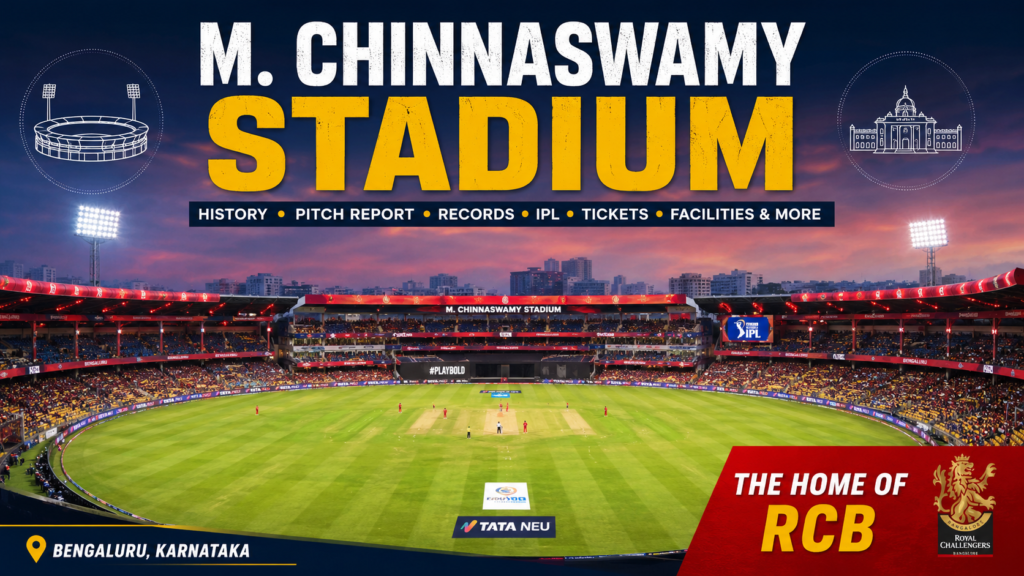

M. Chinnaswamy Stadium is one of India’s most recognizable cricket venues and a landmark sporting destination in Bengaluru, Karnataka. Located in the heart of the city near Cubbon Park and MG Road, the stadium has hosted generations of Indian cricket, from Test matches and ODIs to T20 internationals and IPL contests. It is also the home venue of Karnataka cricket and Royal Challengers Bengaluru (RCB), giving it a special place in both domestic and international cricket. The ICC lists the stadium’s seating capacity at around 40,000.
The ground is particularly famous for its compact boundaries, fast outfield and exciting batting conditions. Over the years, it has witnessed huge scores, spectacular six-hitting and some unforgettable individual performances. Chris Gayle’s 175 not out for RCB in 2013 and several Virat Kohli masterclasses are among the moments that have helped establish Chinnaswamy as one of the IPL’s most entertaining venues.
However, the stadium is much more than an IPL ground. Its history stretches back to the late 1960s, and its name honors Mangalam Chinnaswamy Mudaliar, a prominent cricket administrator who played an important role in the development of cricket in Karnataka and served as BCCI president from 1977 to 1980.
This complete guide covers the M. Chinnaswamy Stadium history, capacity, location, seating plan, pitch report, boundary length, cricket records, IPL history, famous players, tickets, facilities, weather and upcoming matches.
M. Chinnaswamy Stadium Overview
M. Chinnaswamy Stadium is operated by the Karnataka State Cricket Association (KSCA). The venue is owned by the Government of Karnataka and leased to the KSCA for cricket-related activities. It is home to the Karnataka state cricket team and RCB.
| Information | Details |
| Stadium Name | M. Chinnaswamy Stadium |
| Former Name | Karnataka State Cricket Association Stadium |
| Location | Bengaluru, Karnataka, India |
| Established | 1969 |
| First-class cricket | 1972–73 season |
| First Test | India vs West Indies, 1974 |
| Governing Body | Karnataka State Cricket Association |
| Primary Domestic Team | Karnataka |
| IPL Team | Royal Challengers Bengaluru |
| Stadium Type | Cricket Stadium |
| Capacity | Around 40,000 |
| Major Formats | Test, ODI, T20I, IPL |
| Ends | Pavilion End, BEML End |
| Floodlights | Yes |
| Time Zone | IST (UTC+5:30) |
The venue is particularly distinctive because of its central location. Unlike many modern stadiums built on the outskirts of major cities, Chinnaswamy is surrounded by some of Bengaluru’s best-known urban landmarks.
History of M. Chinnaswamy Stadium
Establishment and Early Years
The story of M. Chinnaswamy Stadium began in 1969, when the foundation stone was laid and the process of developing a major cricket ground in Bengaluru got underway. Construction began in 1970, while the stadium was first used for first-class cricket during the 1972–73 season.
At the time, the ground was known as the Karnataka State Cricket Association Stadium, commonly shortened to KSCA Stadium. It gradually became an important home for Karnataka cricket and eventually developed into an international venue.
The stadium received Test status during the 1974–75 season when the West Indies toured India. India’s first Test at the ground against the West Indies was played in November 1974.
Since then, the venue has hosted some of the biggest names in world cricket and has become an established part of India’s international cricket calendar.
Also read this: Royal Challengers Bengaluru vs Rajasthan Royals Timeline | Mumbai Indians vs Delhi Capitals Timeline | Punjab Kings vs Delhi Capitals Match Scorecard
Why Is It Called M. Chinnaswamy Stadium?
The stadium is named after Mangalam Chinnaswamy Mudaliyar, a lawyer and influential cricket administrator from Mandya. He was one of the founding figures associated with the Mysore State Cricket Association, which later became the Karnataka State Cricket Association.
Chinnaswamy served the KSCA for several decades and held senior positions within Indian cricket administration. He was BCCI secretary from 1960 to 1965 and later became BCCI president, serving from 1977 to 1980.
His contribution to the development of the stadium was particularly significant. He was instrumental in helping secure the prime MG Road-area land for cricket in Bengaluru in 1969. The stadium was eventually renamed in his honor.
Interestingly, reports about his life note that Chinnaswamy himself was not particularly keen on having the stadium named after him. Nevertheless, the name became permanent and is now synonymous with Bengaluru cricket.
Location
Evolution of the Stadium
M. Chinnaswamy Stadium has changed considerably since its early years. Its stands, spectator facilities, drainage systems, lighting and other infrastructure have been modernized over time.
One of its most notable developments has been its focus on sustainability. The stadium became known for its solar photovoltaic installation, which was designed to generate a significant portion of the venue’s electricity needs. The ICC describes it as the first cricket stadium in the world to use solar panels to generate a bulk of the electricity needed to operate the stadium.
The venue has also invested in drainage and outfield technology. A water purification plant was added in 2016, followed by an aeration and drainage system designed to reduce delays caused by wet conditions.
These upgrades have helped Chinnaswamy remain relevant despite being one of India’s older major cricket grounds.
M. Chinnaswamy Stadium Capacity
The current widely reported seating capacity of M. Chinnaswamy Stadium is approximately 40,000 spectators. The ICC also lists the venue at 40,000 seats.
The actual number of spectators permitted for an individual match can vary depending on seating configuration, security arrangements, renovation work, event requirements and applicable safety regulations. Therefore, fans should check the ticket information for the specific fixture rather than assuming that every match will use the full theoretical capacity.
The stadium includes different categories of seating and hospitality areas, including general spectator stands, premium sections, corporate facilities and areas used by players and officials.
M. Chinnaswamy Stadium Seating Plan
The seating arrangement can change according to the event, but the stadium broadly includes:
- General spectator stands
- Premium and hospitality seating
- Corporate boxes
- VIP areas
- Pavilion facilities
- Media facilities
- Player areas
- Administrative and match-official sections
For IPL matches, ticket categories can differ significantly in price and location. Fans should always check the official ticket information for the particular RCB or international fixture before purchasing.
M. Chinnaswamy Stadium Location and Address
M. Chinnaswamy Stadium is situated in central Bengaluru, making it one of the more accessible major cricket grounds in India.
It is located around MG Road, Bengaluru, Karnataka, close to Cubbon Park and other important central-city landmarks. The ICC describes the stadium as being flanked by Cubbon Park, Queen’s Road and MG Road.
Its central location is one of its biggest advantages. Fans traveling from different parts of Bengaluru can use the city’s metro, buses, taxis and other public transportation options.
How to Reach M. Chinnaswamy Stadium
By Metro: Bengaluru Metro is one of the most convenient options for reaching the stadium. The central location means visitors can use nearby metro stations and continue on foot or by local transport.
By Bus: BMTC buses connect central Bengaluru with numerous neighborhoods across the city. Routes vary, so checking the latest public transport information on match day is advisable.
By Train: Bengaluru’s major railway terminals can be used by visitors arriving from outside the city. From the railway station, fans can continue by metro, taxi or bus.
By Taxi or Cab: App-based taxis and local cabs are widely used for stadium travel. However, traffic restrictions and road closures may be introduced during major matches.
By Private Vehicle: Driving is possible, but parking around the stadium can become difficult during IPL and international matches. Public transportation is often the more practical option on busy match days.
Nearest Metro Station to M. Chinnaswamy Stadium
For visitors using Bengaluru Metro, stations around the central business district provide practical access to the stadium. The exact station and walking route can depend on the active metro network and the stadium entrance mentioned on the ticket.
Because match-day traffic management can change, visitors should check the latest Bengaluru Metro and event instructions before traveling rather than relying solely on an older route guide.
M. Chinnaswamy Stadium Pitch Report
The M. Chinnaswamy Stadium pitch has traditionally been associated with attacking cricket, especially in limited-overs matches. The relatively compact playing area, quick outfield and Bengaluru conditions can make stroke-making rewarding.
That does not mean the ground is automatically easy for every batter. Bowlers who vary their pace, hit good lengths and use changes of angle can still create problems. In longer formats, the pitch can offer a more varied contest between bat and ball as the match progresses.
In T20 cricket, however, teams generally value aggressive powerplay batting because a strong start can create a platform for a large total.
Is M. Chinnaswamy Stadium a Batting-Friendly Ground?
Yes, M. Chinnaswamy Stadium is generally considered batting-friendly, particularly in T20 cricket.
Its reputation comes from several factors:
- Compact boundaries
- Quick outfield
- Good ball travel
- High-scoring IPL history
- Strong scoring opportunities in the powerplay
- Excellent conditions for six-hitting when batters are set
Historical IPL data also demonstrates how often the ground has produced big totals. RCB’s official website previously highlighted the large number of 180-plus scores at the venue and described the small boundaries as a major reason for its batting-friendly character.
At the same time, conditions can change from match to match. Pitch preparation, weather, humidity, dew and the quality of the bowling attack can all influence the actual scoring pattern.
M. Chinnaswamy Stadium Average Score
Average scores vary according to the database, date range and format used. For example, recent T20 statistics published by Cricbuzz list an average first-innings score of 141 across its T20 record set, while IPL-specific datasets show considerably higher scoring because IPL matches are played under different conditions and over a longer historical sample.
For SEO content, it is better to specify the format and dataset rather than presenting one number as the universal “average Chinnaswamy score.”
| Format | Typical Scoring Pattern | Pitch Trend |
| Test | Can produce large totals, but conditions evolve | Balanced over time |
| ODI | Generally favorable for stroke-making | Batting-friendly |
| T20I | Competitive scoring with aggressive batting | Batting-friendly |
| IPL | Frequently high-scoring | Strongly favors attacking batting |
M. Chinnaswamy Stadium Boundary Length
One of the most important characteristics of M. Chinnaswamy Stadium is its relatively compact playing dimensions.
The shorter boundaries make it easier for powerful batters to clear the ropes, particularly when the ball comes onto the bat well. This is one reason the venue has produced some of the most memorable six-hitting performances in IPL history.
Boundary dimensions can differ depending on the direction of the shot and the match-day setup, so a single number should not be treated as a fixed measurement for every match.
The impact is especially visible during the final overs of T20 innings. Batters can target the shorter side, while bowlers must carefully consider their lines and lengths.
M. Chinnaswamy Stadium Cricket Records
The stadium has produced outstanding numbers across Test, ODI, T20I and IPL cricket.
Test Records at M. Chinnaswamy Stadium
The Test history of the ground includes several remarkable performances. India’s 626 against Pakistan in 2007 remains among the biggest team totals recorded at the venue, while India’s 46 against New Zealand in 2024 stands as a dramatic low point.
| Test Record | Performance |
| Highest Team Total | 626 – India vs Pakistan, 2007 |
| Lowest Completed Innings | 46 – India vs New Zealand, 2024 |
| Highest Individual Score | 267 – Younis Khan vs India, 2005 |
| Best Match Bowling | 11/224 – Harbhajan Singh vs Australia, 2004 |
| Most Test Runs at Venue | Sachin Tendulkar – 869 |
| Most Test Wickets at Venue | Anil Kumble – 41 |
Younis Khan’s 267 remains one of the outstanding individual Test innings at the ground, while Harbhajan Singh’s match figures of 11/224 against Australia in 2004 underline the fact that the venue has also produced memorable bowling performances.
ODI Records at M. Chinnaswamy Stadium
The venue has hosted important World Cup and bilateral ODI matches. Its ODI history includes Rohit Sharma’s famous 209 against Australia in 2013 and Ireland’s successful chase of 329 against England during the 2011 World Cup.
| ODI Record | Performance |
| Highest Team Total | 410/4 – India vs Netherlands, 2023 |
| Highest Individual Score | 209 – Rohit Sharma vs Australia, 2013 |
| Highest Successful Chase | 329/7 – Ireland vs England, 2011 |
| Most ODI Runs at Venue | Sachin Tendulkar – 534 |
| Most ODI Wickets at Venue | Zaheer Khan – 14 |
| Notable Best Bowling | 5/31 – Yuvraj Singh vs Ireland, 2011 |
India’s 410/4 against the Netherlands in the 2023 World Cup is the highest ODI total listed for the venue, while Rohit Sharma’s 209 remains its highest individual ODI score.
T20I Records at M. Chinnaswamy Stadium
The venue has also hosted memorable T20 internationals. One of the most extraordinary came in January 2024, when India and Afghanistan played a match featuring two Super Overs. Rohit Sharma scored a century in the contest, making it one of the most unusual T20I matches in international cricket history.
Because the number of T20Is at the venue is much smaller than the number of IPL matches, T20I records should be interpreted separately from the IPL statistics.
| T20I Record | Notable Figure |
| Highest T20I Total | 212/4 – India vs Afghanistan |
| Highest Successful Chase | 194/3 – Australia vs India |
| Average 1st-Innings Score | Around 141 in the cited T20I dataset |
| Average 2nd-Innings Score | Around 136 |
| Major T20I Moment | India vs Afghanistan, two Super Overs in 2024 |
The precise record book can change as new international matches are played, so current statistics should always be checked against an updated cricket database.
IPL Records at M. Chinnaswamy Stadium
The IPL is where Chinnaswamy has developed perhaps its strongest identity.
| IPL Record | Performance |
| Highest Team Total | 287/3 – SRH vs RCB, 2024 |
| Lowest Team Total | 82 – RCB vs KKR, 2008 |
| Highest Individual Score | 175* – Chris Gayle, RCB vs Pune Warriors, 2013 |
| Best Bowling Figures | 4/9 – Samuel Badree, RCB vs MI, 2017 |
| Famous RCB Team Total | 263/5 – RCB vs Pune Warriors, 2013 |
| Highest Successful Chase | 213/9 – LSG vs RCB, 2023 |
The 287/3 scored by Sunrisers Hyderabad against RCB in 2024 is currently the highest IPL team total at the stadium.
Chris Gayle’s 175 not out from 66 balls against Pune Warriors in 2013 remains the most iconic individual IPL performance at Chinnaswamy. It was also part of RCB’s 263/5, one of the highest totals in IPL history at the time.
At the other end of the scale, RCB were bowled out for 82 by Kolkata Knight Riders in the very first IPL match at the venue in 2008, when Brendon McCullum scored his famous 158 not out.
M. Chinnaswamy Stadium IPL History
The first IPL match at M. Chinnaswamy Stadium was played in April 2008. Since then, the ground has become inseparable from the identity of RCB.
The combination of a central Bengaluru location, passionate supporters and an aggressive batting environment has made RCB home games some of the most anticipated fixtures of every IPL season.
The stadium has also hosted an extraordinary range of IPL scores. It has seen totals below 100 as well as totals approaching 300, illustrating how quickly a match can change at the venue.
Royal Challengers Bengaluru at Chinnaswamy Stadium
RCB’s relationship with Chinnaswamy is one of the most recognizable home-ground associations in the IPL.
Virat Kohli has been particularly important to this relationship. RCB’s own statistical overview previously highlighted Kohli’s enormous run tally at the venue and his exceptional 2016 IPL season, when he scored 973 runs overall.
Chris Gayle and AB de Villiers have also played unforgettable innings at the ground. Their combination of power and innovation suited the venue’s dimensions perfectly.
The crowd is another defining feature. During RCB matches, the stadium is commonly filled with red jerseys, flags, chants and strong support for the home team. That atmosphere has become part of the Chinnaswamy experience.
Famous RCB Matches at M. Chinnaswamy Stadium
| Year | Match | Result | Key Performer |
| 2008 | RCB vs KKR | KKR won | Brendon McCullum |
| 2013 | RCB vs Pune Warriors | RCB won | Chris Gayle |
| 2017 | RCB vs MI | RCB won | Samuel Badree |
| 2024 | RCB vs SRH | SRH won | Travis Head / SRH batting unit |
| 2026 | RCB vs CSK | RCB won by 43 runs | RCB batting unit |
The 2008 KKR match is remembered for McCullum’s 158*, while the 2013 game against Pune Warriors remains famous because of Gayle’s 175*. The 2024 contest against SRH produced the venue’s current IPL record total of 287/3.
Famous Matches Played at M. Chinnaswamy Stadium
The venue has witnessed major matches across formats.
In Test cricket, the first Test came against the West Indies in 1974. The ground has subsequently hosted matches involving Australia, Pakistan, New Zealand, Sri Lanka, Afghanistan and other international sides.
The 2005 Test between India and Pakistan produced Younis Khan’s 267, while the 2007 Test saw India score 626 against Pakistan. The ground has therefore played host to major batting landmarks in Test cricket.
In ODIs, Rohit Sharma’s 209 against Australia in 2013 stands out. The 2011 World Cup match between England and Ireland is another memorable encounter because Ireland chased 329 successfully.
T20 cricket has added another chapter, particularly the extraordinary India-Afghanistan match in January 2024 that required two Super Overs to determine the winner.
M. Chinnaswamy Stadium Famous Players and Performances
Virat Kohli at M. Chinnaswamy Stadium
Virat Kohli’s association with Chinnaswamy is one of the strongest player-ground connections in modern IPL cricket.
As RCB’s long-term batting leader, Kohli has produced numerous important innings at the venue. His consistency, ability to pace an innings and understanding of the ground’s dimensions have made him one of the stadium’s defining performers.
RCB’s official statistical overview previously recorded Kohli as the venue’s leading batter across formats at the time of publication, highlighting his enormous Bengaluru connection.
His relationship with the stadium goes beyond statistics. The RCB crowd’s support for Kohli has become a major part of the atmosphere during IPL matches.
Other Famous Batters
- Chris Gayle: His unbeaten 175 from 66 balls in 2013 is arguably the single most famous IPL innings played at Chinnaswamy.
- AB de Villiers: The former RCB star delivered several explosive innings at the venue and became another fan favorite.
- Rohit Sharma: His 209 against Australia in the 2013 ODI remains the highest individual ODI score recorded at the ground.
- Younis Khan: His 267 against India in 2005 is the highest individual Test score at the venue.
Famous Bowlers
Although Chinnaswamy is often described as a batting venue, bowlers have also produced memorable spells.
Anil Kumble has a particularly strong connection with the ground and is the leading Test wicket-taker at the venue according to published records. Harbhajan Singh’s 11-wicket match haul against Australia in 2004 is another major Test bowling performance.
In the IPL, Samuel Badree’s 4/9 against Mumbai Indians in 2017 remains one of the standout bowling figures at the ground.
M. Chinnaswamy Stadium Tickets
Ticket availability and prices depend heavily on the match.
For IPL games, prices can vary according to the stand, hospitality category, opponent, match importance and demand. International matches can have a different pricing structure.
Fans should purchase tickets only through the official ticketing channel announced for the particular fixture. Avoid unofficial sellers and suspiciously discounted tickets, especially for high-demand RCB matches.
Before entering the stadium, spectators should check:
- Match ticket and seat details
- Entry gate
- Valid photo identification requirements
- Prohibited items
- Bag restrictions
- Reporting time
- Parking or public transport instructions
- Stadium-specific security rules
M. Chinnaswamy Stadium Ticket Price
There is no single fixed ticket price for the stadium because prices vary by match and seating category.
| Ticket Category | Typical Pricing Approach |
| General Stand | Usually lower-priced category |
| Premium Stand | Higher than general seating |
| Corporate/Hospitality | Premium pricing |
| VIP/Executive Areas | Match-specific |
| IPL Tickets | Demand and stand dependent |
| International Match Tickets | Fixture and category dependent |
For accurate prices, fans should use the official sales information for the specific match rather than relying on old ticket-price articles.
M. Chinnaswamy Stadium Facilities
The stadium has undergone several modernization projects to improve the experience for spectators, players and officials.
Major facilities and features include:
- Spectator seating
- Floodlights
- Corporate and hospitality areas
- Player dressing rooms
- Media facilities
- Food and beverage areas
- Match-day security
- Medical and emergency facilities
- Modern drainage infrastructure
- Improved outfield management
- Accessibility provisions
- Administrative facilities
The venue’s drainage system is particularly useful in Bengaluru’s sometimes unpredictable weather. The ICC notes that the stadium introduced an aeration and drainage system designed to prevent matches from being heavily affected by a wet outfield.
Its solar-energy infrastructure is another notable feature. The venue’s sustainability efforts have helped give it an identity beyond cricket.
M. Chinnaswamy Stadium Weather
Bengaluru has a relatively moderate climate compared with many Indian cities, but rain can still be an important factor for cricket matches.
During the monsoon and periods of heavy rainfall, showers can interrupt play. The stadium’s modern drainage and outfield systems help reduce the impact of rain, but persistent weather can still cause delays.
Evening IPL matches can also experience dew. A wet outfield may make it more difficult for bowlers to grip the ball, while the ball can skid more easily for batters.
Weather can therefore influence the toss decision. Captains may prefer chasing when they expect dew, although the correct strategy ultimately depends on the pitch, weather and strength of both teams.
M. Chinnaswamy Stadium Upcoming Matches
Fixtures at Chinnaswamy change regularly because the stadium hosts IPL, international and domestic cricket.
As of the currently available fixture information, an India-West Indies T20I is listed at M. Chinnaswamy Stadium for 17 October 2026 at 7:00 PM local time.
| Date | Match | Format | Teams | Start Time |
| 17 October 2026 | 5th T20I | T20I | India vs West Indies | 7:00 PM IST |
Because fixtures, venues and timings can be changed by the relevant cricket authorities, readers should verify the latest schedule before planning travel or purchasing tickets.
M. Chinnaswamy Stadium vs Other Major Indian Stadiums
M. Chinnaswamy has a very different character from several other famous Indian cricket grounds.
| Stadium | City | Approx. Capacity | Known For |
| M. Chinnaswamy Stadium | Bengaluru | 40,000 | Compact boundaries and high-scoring cricket |
| Wankhede Stadium | Mumbai | 30,000+ | Batting and major Mumbai cricket |
| Eden Gardens | Kolkata | 60,000+ | Historic atmosphere and large crowds |
| Narendra Modi Stadium | Ahmedabad | 100,000+ | World’s largest cricket stadium |
| MA Chidambaram Stadium | Chennai | 30,000+ | Historic venue and spin-friendly reputation |
The biggest difference is scale. Narendra Modi Stadium is vastly larger in capacity, while Chinnaswamy’s strength is its central location and intimate, energetic atmosphere.
Compared with traditional spin-friendly venues such as Chennai, Bengaluru is generally more associated with fast scoring and shorter boundaries.
Interesting Facts About M. Chinnaswamy Stadium
Here are some of the most interesting facts about the venue:
- The stadium was originally known as the Karnataka State Cricket Association Stadium.
- The foundation stone was laid in 1969, with construction beginning in 1970.
- The first-class cricket use began in the 1972–73 season.
- The first Test was played in 1974, when India faced the West Indies.
- The stadium is named after M. Chinnaswamy, a major cricket administrator and former BCCI president.
- It is located in the heart of Bengaluru, close to Cubbon Park and MG Road.
- It is the home venue of RCB, making it one of the most recognizable grounds in the IPL.
- Chris Gayle scored 175 from 66 balls here in 2013*, one of the most iconic IPL innings ever played.
- SRH scored 287/3 against RCB in 2024, setting the current highest IPL total at the venue.
- The stadium has major sustainability initiatives, including solar panels and improved water-management systems.
M. Chinnaswamy Stadium Quick Facts
| Quick Fact | Information |
| Full Name | M. Chinnaswamy Stadium |
| City | Bengaluru |
| State | Karnataka |
| Established | 1969 |
| First-class Cricket | 1972–73 |
| First Test | 1974 |
| Home Team | Karnataka |
| IPL Team | Royal Challengers Bengaluru |
| Capacity | Around 40,000 |
| Former Name | Karnataka State Cricket Association Stadium |
| International Status | Yes |
| Major Formats | Test, ODI, T20I |
| Famous For | High-scoring cricket and RCB matches |
| IPL Highest Total | 287/3 – SRH, 2024 |
| IPL Highest Individual Score | 175* – Chris Gayle, 2013 |
| Test Highest Individual Score | 267 – Younis Khan, 2005 |
| ODI Highest Individual Score | 209 – Rohit Sharma, 2013 |
Conclusion
M. Chinnaswamy Stadium is much more than the home of Royal Challengers Bengaluru. It is one of the historic centers of Indian cricket, with a story that stretches from the foundation of the ground in 1969 to major Test, ODI, T20I and IPL moments in the modern era.
Its connection with M. Chinnaswamy Mudaliyar gives the venue historical importance, while its relationship with Karnataka cricket and RCB gives it enormous popularity among modern cricket fans.
The stadium’s compact boundaries and fast outfield have produced spectacular batting performances, including Chris Gayle’s 175*, Rohit Sharma’s 209 and some of the IPL’s biggest team totals. At the same time, its Test history shows that the ground can also produce memorable bowling performances and dramatic contests.
With a capacity of around 40,000, a central Bengaluru location, modern facilities and a passionate fan base, M. Chinnaswamy Stadium remains one of India’s most important and recognizable cricket venues. For cricket fans, particularly RCB supporters, a match at Chinnaswamy is not simply another fixture—it is an experience closely connected with Bengaluru’s cricket culture.
FAQs
Where is M. Chinnaswamy Stadium located?
M. Chinnaswamy Stadium is located in central Bengaluru, Karnataka, near prominent landmarks including Cubbon Park and MG Road.
What is the capacity of M. Chinnaswamy Stadium?
The stadium has a reported seating capacity of approximately 40,000 spectators. The ICC also lists its capacity at 40,000.
What is the old name of M. Chinnaswamy Stadium?
The stadium was formerly known as the Karnataka State Cricket Association Stadium, commonly called the KSCA Stadium.
Which IPL team plays at M. Chinnaswamy Stadium?
Royal Challengers Bengaluru (RCB) use M. Chinnaswamy Stadium as their home venue in the IPL.
Is M. Chinnaswamy Stadium batting-friendly?
Yes. The venue is generally regarded as batting-friendly, particularly in T20 cricket, because of its relatively short boundaries and quick outfield.
What is the highest IPL score at M. Chinnaswamy Stadium?
The highest IPL team total currently listed at the stadium is 287/3 by Sunrisers Hyderabad against RCB in 2024.
What is the highest individual IPL score at Chinnaswamy Stadium?
Chris Gayle holds the record with an unbeaten 175 from 66 balls for RCB against Pune Warriors in 2013.
What is the average T20 score at Chinnaswamy Stadium?
Average scores depend on whether the statistic refers to T20 internationals, IPL matches or another T20 competition. One current T20I dataset lists the average first innings at around 141, while IPL-specific figures are substantially higher.
What is the nearest metro station to M. Chinnaswamy Stadium?
The stadium is located in central Bengaluru and can be reached using nearby Bengaluru Metro stations. Because station access and match-day traffic arrangements can change, visitors should check the latest metro route before traveling.
How can I buy Chinnaswamy Stadium tickets?
Tickets should be purchased through the official ticketing channel announced for the specific match. IPL and international ticket prices vary according to the match and seating category.
Why is Chinnaswamy Stadium famous?
The stadium is famous for its long international history, central Bengaluru location, association with RCB, passionate supporters, compact boundaries and memorable high-scoring matches.
When was M. Chinnaswamy Stadium built?
The foundation stone was laid in 1969, construction began in 1970, and the ground was first used for first-class cricket during the 1972–73 season.
What is the boundary length at Chinnaswamy Stadium?
Boundary dimensions vary according to direction and match configuration, but the venue is widely known for its relatively short boundaries. This is one of the main reasons it has developed a reputation as a high-scoring IPL ground.